
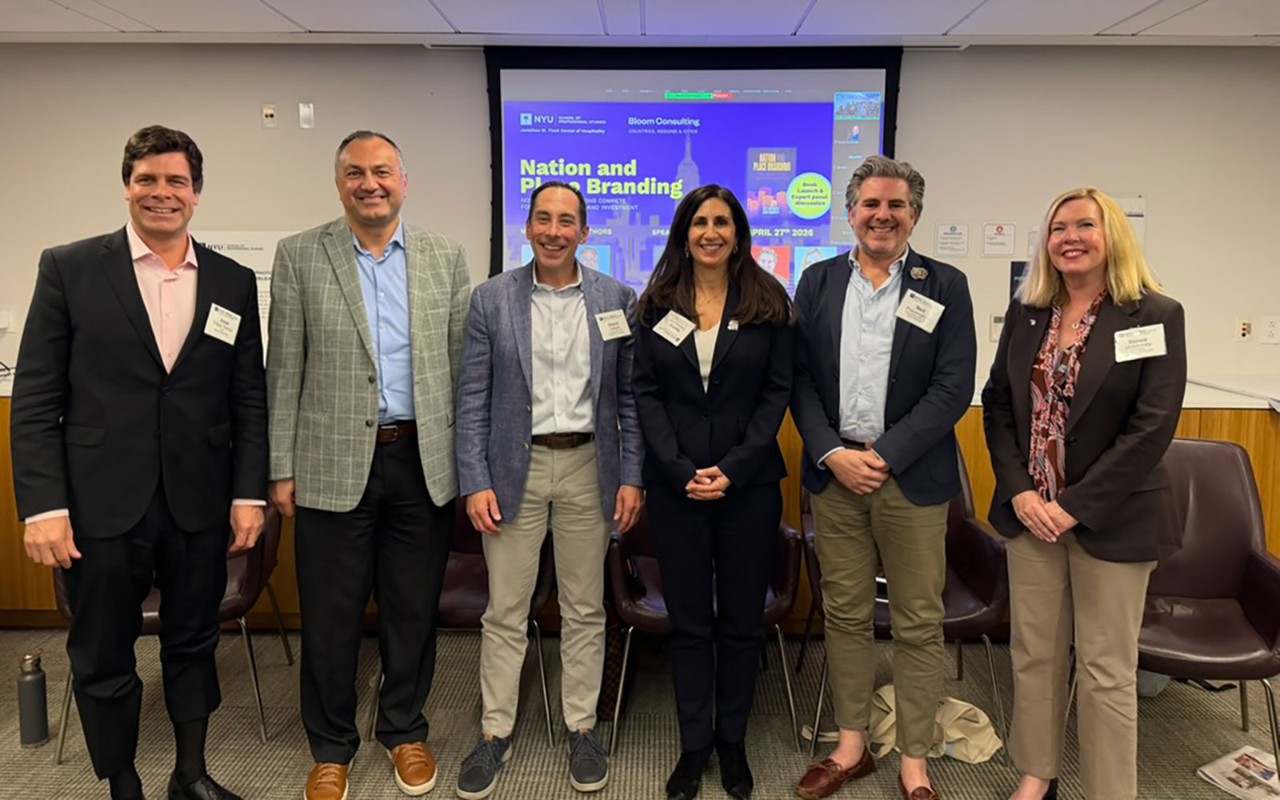
<p><span class="p-body">On April 27, 2026, the NYU School of Professional Studies Jonathan M. Tisch Center of Hospitality partnered with <b><a href="https://www.bloom-consulting.com/" target="_blank">Bloom Consulting</a> </b>to host “<b>Nation and Place Branding</b>,” a book launch and expert panel discussion for Dr. Richie Karaburun’s new book that was co-authored with Jose Filipe Torres, CEO of Bloom Consulting. Bringing together leaders from organizations like <b>NYC Tourism + Conventions, Destination Cleveland, Visit Philadelphia</b>, and <b>Tulsa Regional Tourism</b>, the discussion offered a real-world look into how cities define themselves and shape global perception.</span></p>
<p><span class="p-body">A major theme throughout the conversation was the difference between branding and marketing, which many stakeholders still tend to blur. Branding was described as the “heart” of a place, the emotional essence that defines how a destination feels and what it represents. Marketing, in contrast, is more short-term and tactical, often centered around campaigns and measurable KPIs. The panelists emphasized that without a strong brand foundation, marketing efforts lack meaning, but without marketing, a brand cannot effectively reach its audience. The two must work together, but branding should always lead.</span></p>
<p><span class="p-body">Each destination shared how they are working to define or refine their “central idea,” a clear and ownable identity that differentiates them. Cleveland was described as embodying “sophisticated grit,” rooted in resilience and pride, while New York City leaned into its identity as a place where anyone can find belonging and opportunity. Philadelphia is still evolving its core narrative, balancing its historic significance with its value as an accessible and impactful destination, and Tulsa is continuing to shape an authentic, all-American story grounded in community and cultural heritage. Across the board, it was clear that successful place branding is not about being everything to everyone, but about being intentional and authentic in what a place stands for.</span></p>
<p><span class="p-body">Another key takeaway was the idea that destinations are often “friends and not competitors.” While cities may compete for visitors, talent, and investment, they also rely heavily on collaboration, especially internally. Aligning stakeholders, from economic development corporations to chambers of commerce, around a unified story remains one of the biggest challenges in place branding. The idea of “cooperating to compete” highlighted how important it is for organizations to work together to create consistency in messaging while still differentiating themselves globally.</span></p>
<p><span class="p-body">The panel also explored how the digital landscape is rapidly shifting. Traditional strategies focused on driving users to websites are becoming less central, as attention shifts toward AI, large language models, and user-generated content. Platforms like Reddit and the rise of influencers were highlighted as key drivers of perception, along with the growing importance of earned media. Destinations are now thinking about how they appear in AI-generated responses, whether their brand voice is consistent across platforms, and how local creators can help tell more authentic stories. In this evolving space, AI is no longer just a tool but an active participant in shaping a destination’s image.</span></p>
<p><span class="p-body">Events were also discussed as powerful tools for placemaking and branding. Large-scale opportunities like the FIFA World Cup, as well as cultural moments like those tied to the Rock and Roll Hall of Fame, were framed as more than just short-term economic drivers. They create long-term legacy, generate global visibility, and foster local pride. Even smaller events can play a meaningful role in shaping how residents and visitors connect with a place, often serving as an entry point for people who may not have otherwise considered visiting.</span></p>
<p><span class="p-body">To close, the panelists offered advice for students interested in entering the industry, emphasizing the importance of gaining experience early, building relationships, and staying open-minded. They highlighted that careers in this space are rarely linear and that success often comes from making connections and being willing to explore different paths. Above all, they encouraged students to stay authentic and not feel pressured to emulate others, reinforcing the same principle that defines strong place branding.</span></p>
<p><span class="p-body">Overall, the event underscored that perception is at the core of everything. Before someone visits, invests in, or moves to a place, they already have an idea of what it represents. The role of destination marketers is not just to promote a location, but to intentionally shape that perception in a way that is both compelling and true.</span></p>