
<p><i>This article was originally published on May 1, 2024</i></p>
<p><span class="p-body">On April 17th, I attended the Speakers on the Square event alongside a community of writers, editors, avid readers, and fellow publishing students. Allison Dobson, President of Penguin Publishing Group at Penguin Random House, introduced award-winning author, journalist, and NYU professor Pamela Newkirk, who would be moderating the event, as well as the featured speaker James McBride, author of the bestselling novel and Barnes & Noble’s 2023 book of the year, <i>The Heaven and Earth Grocery Store</i>.</span></p>
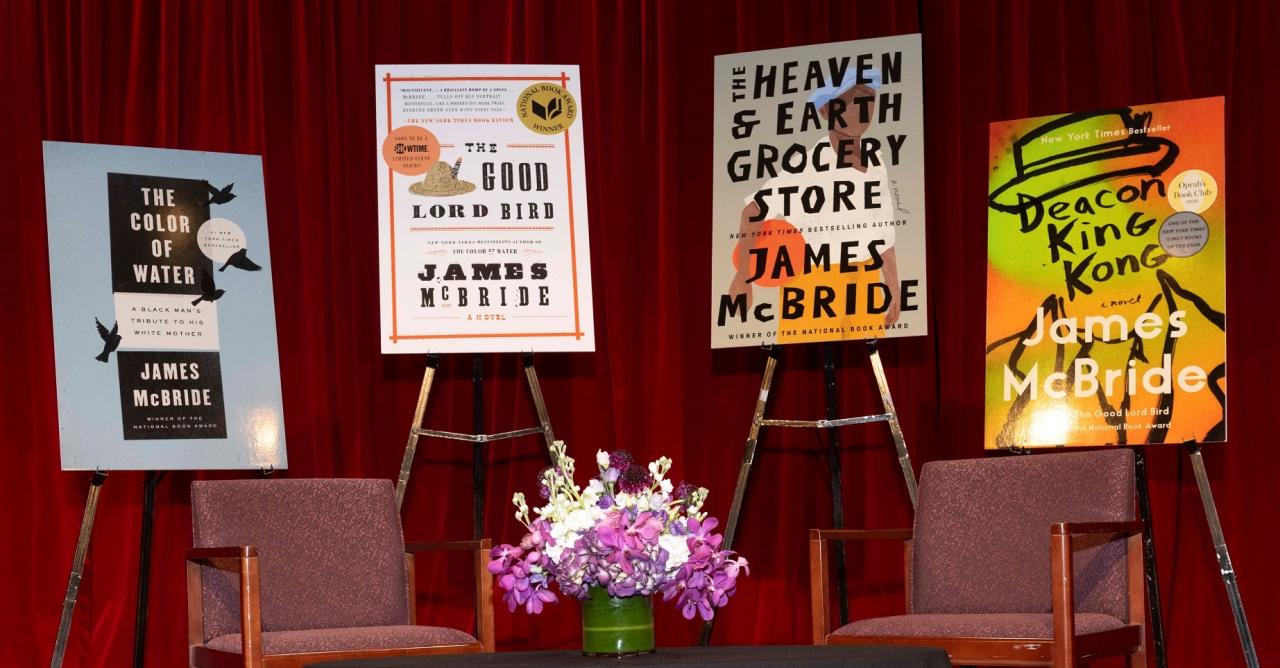
<p><span class="p-body">Pamela and James, sat center stage, large displays of the covers of McBride’s books forming their backdrop. Immediately, the pair set the tone with some lighthearted jokes, their kinship evident to all in attendance.</span></p>
<p><span class="p-body">“I know you would much rather be playing your sax than talking to me about your life and work, but here we are, and we’re going to have fun.” Pamela smiled.</span></p>
<p> </p>
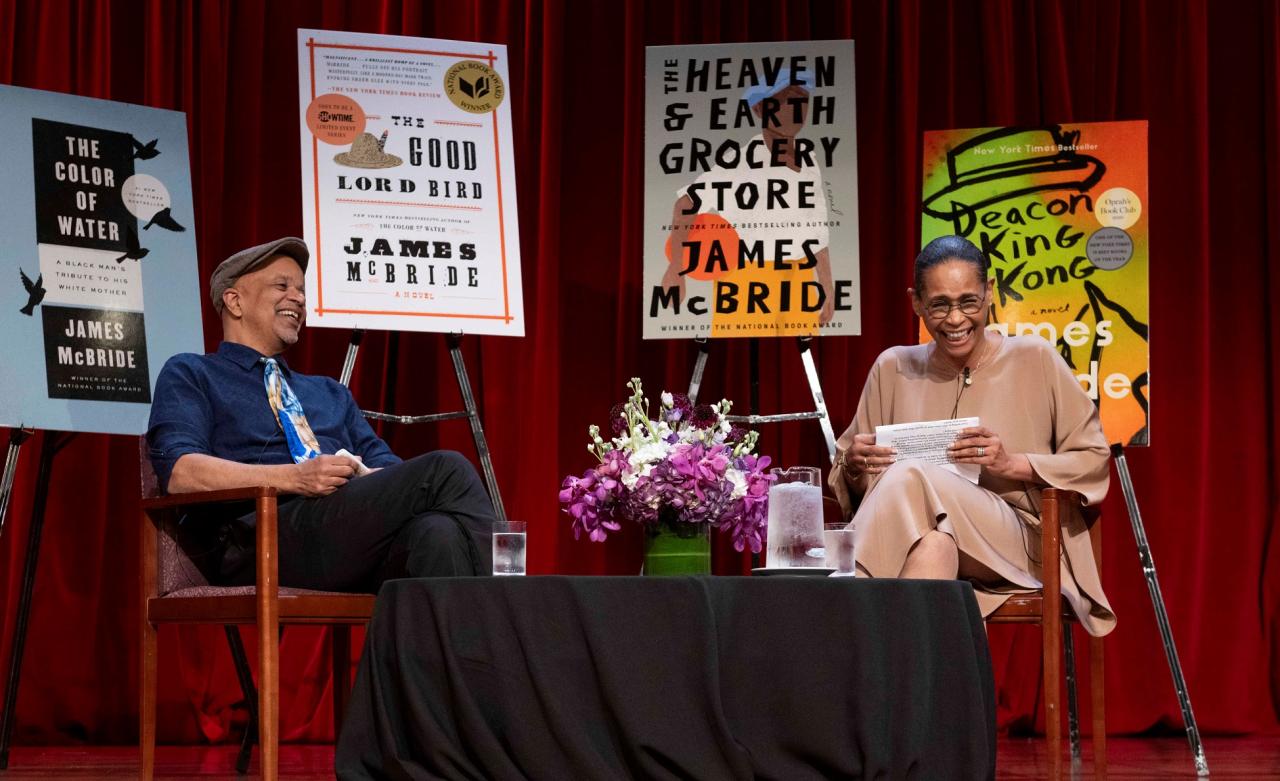
James McBride (left) in conversation with Pamela Newkirk (right)
Background
<p><span class="p-body">Pamela acknowledged James for his many accomplishments, mentioning not only his worldwide success as an author, but his passion for music, his devotion to his family, and his love for his church. She then asked, “How is it that you manage to juggle all of these roles, and how do they intersect with your life and work?”</span></p>
<p><span class="p-body">“Well, Pam,” James began, with a humorous tone that incited multiple snickers from the audience. “I don’t know… I just work. I’m a working person, I don’t really take vacations. I do what I like to do, so I don’t really need to go to the beach. [...] I’m from New York, we know how to work here.”</span></p>
<p><span class="p-body">James paid homage to the late author and journalist, Pete Hamill, whose work ethic had a measurable influence on James McBride’s career. He said, simply, but with great reverence, “I consider myself more of an artist than anything else. As an artist, you’re called to do something. [...] Writing–it calls you, you know. Writing chooses you. You have to respond to it. And a lot of it is luck, luck that I’ve written some books that people can relate to.”</span></p>
<p><span class="p-body">McBride explained that his career in writing began when, inspired by Nelson Mandela, he applied to a journalism program to help change the world.</span></p>
On Writing Style & Success
<p><span class="p-body">Pamela: “Your work has been described as lyrical.”</span></p>
<p><span class="p-body">James: “Everything you do has some sort of structure. As long as you stay in the harmonic context, you’ll know what you’re doing. Writing is the same way. Fiction allows you to realize your dreams.”</span></p>
<p><span class="p-body">Pamela: “Why did this book resonate with readers and critics?”<br>
</span></p>
<p><span class="p-body">James: “Short answer: Jewish women read.” (Cue a chorus of laughter and applause from the crowd). James returned to the conversation with a serious tone. “Readers are looking for places we can meet and talk sensibly about things that are difficult. [...] There is nothing to be afraid of. The bigger the wall, the harder you push, in the end, everything is going to be alright.”</span></p>
Diversity, Equity, Inclusion, & The Truth
<p><span class="p-body"><i>The Heaven and Earth Grocery Store </i>dives deep into the social construct of a small Pennsylvanian town in the 1920s, touching profoundly on matters of race, gender, disability, love, life, and death.</span></p>
<p><span class="p-body">Pamela noted that many of James McBride’s novels have themes pertaining to Jewish and African American heritage. James then opened up about how the unique circumstances of his childhood encouraged him to write about a part of life that many people don’t pay attention to. For him in particular, that meant showing a part of Black life in New York that hadn’t yet been spotlighted, as well as a tender and empathetic side of the Jewish community. James observed that, in some regards, Jewish and African American communities mirror each other, and he wanted to bring those observations to the surface. He passionately emphasized that he is interested in what brings these communities together: “everyone can point out what’s wrong, but this doesn’t heal the world.”</span></p>
<p><span class="p-body">When Pamela inquired about James’ observations of diversity in the publishing industry, James shared that he has not noted any big changes. He believes the publishing workforce still has too few Black and BIPOC editors, and as such, there is an inability for many publishers to identify what a Black audience is truly looking for.</span></p>
<p><span class="p-body">James recounted his experience being awarded the National Humanities Medal by President Barack Obama, in 2016. According to James, the only words Obama said to him were, “I appreciate you.” When your job is to make people happier, James remarked, questions of identity are less significant than your conviction and your commitment to the truth: “You do an E. Jean Carroll - when you raise your fist, you strike as hard as you can, then you walk off into the sunset and say, ‘okay, lemonade anyone?’”</span></p>
Writing Routines & the Editing Process
<p><span class="p-body">In his writing process, James focuses first on the psychological development of his characters, and allows for the story to take shape organically, based on how those characters interact with each other. The nuanced journey of his characters is the true destination.</span></p>
<p><span class="p-body">When asked about his experience with his editor Jake Morrissey, James commented that the overall editing relationship between himself and Jake seems to “be working pretty darn good.” When James hands in a book, he tries to hand it in clean. He said many of his chapters are rewritten 25-30 times before he is satisfied. As he rereads and edits his own work, his aim is to give readers space to respond to the work, instead of giving them reason to put the book down and just say “forget it.”</span></p>
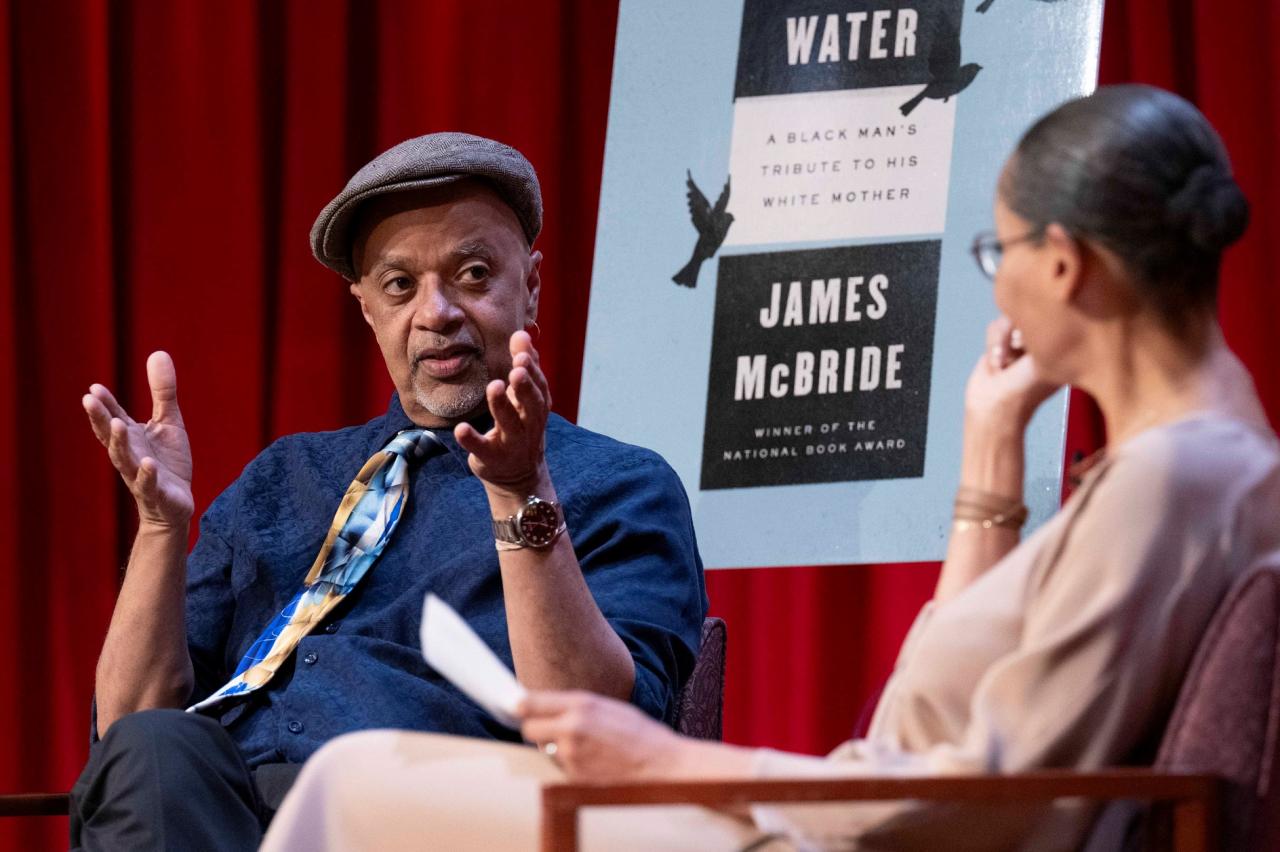
<p><span class="p-body">His advice to writers? Learn how to handle rejection. Motioning to the display behind him, he said, “when you read my books, you’re looking at my few successes, you don’t see all the things that failed.”</span></p>
His Next Project
<p><span class="p-body">To close out the conversation, Pamela asked James what he’s working on these days. James shared that the setting of his new story appears to be New York in the early 1900s, but he hasn’t found the characters yet, so he’s not sure where the story will take him. He hopes to weave elements of jazz into his story, but he noted that jazz is not easy to write about.</span></p>
When All Was Said and Done
<p><span class="p-body">The event concluded with enthusiastic applause. James McBride and Pamela Newkirk had generously filled the tables of our minds with food for thought. I left the building, taking some of that feast to-go, in the hopes I could sit with the discourse again later.</span></p>
<p><span class="p-body"><i>Madisen Christoffersen is a current MS in Publishing student graduating in May 2025. She is currently a marketing & publicity intern for Workman Publishing, Hachette Book Group. Her goal is to become a successfully published novelist while simultaneously building a strong publishing career in marketing or sales.</i></span></p>


Accessibility
Digital Privacy Statement
University Policies
Web Policy
Academic Accreditation
New York University
New York University
New York University
Equal Opportunity and Non-Discrimination at NYU - New York University is committed to maintaining an environment that encourages and fosters respect for individual values and appropriate conduct among all persons. In all University spaces—physical and digital—programming, activities, and events are carried out in accordance with applicable law as well as University policy, which includes but is not limited to its Non-Discrimination and Anti-Harassment Policy.