
<p>How do we prepare students for tomorrow’s global workplaces? By transforming how we teach today, with intersectional and interdisciplinary approaches that expand thinking and real-world impact across cultures and disciplines.</p>
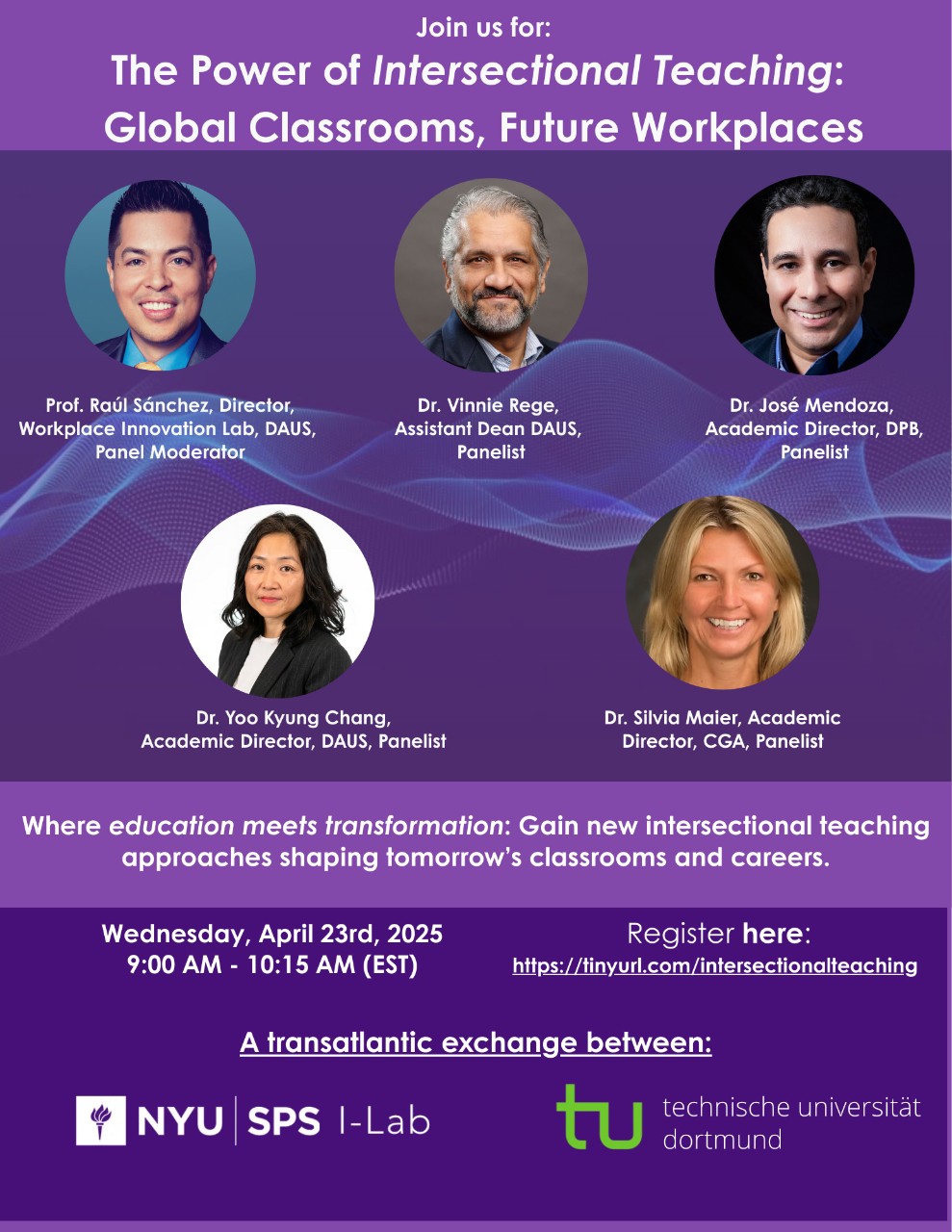
<p>In April 2025, the Workplace Learning Innovation Lab, in collaboration with the NYU School of Professional Studies and TU Dortmund University (Germany), hosted a transatlantic event to explore how interdisciplinary frameworks can innovate the future of teaching and workforce development. With virtual participants across both the US and Germany, the session created space for intersectional and intercultural dialogue, practical strategy-sharing, and global faculty peer learning. The discussion emphasized that interdisciplinarity should not be treated merely as a broad theoretical concept, but rather as a practical framework actively applied within diverse fields of research, across teaching practices, and in global workspaces.</p>
<p><b>Event Highlights:</b></p>
<ul class="p-list">
<li>Faculty representation from both NYU SPS and TU Dortmund institutions and multiple countries, creating a transcultural dialogue and model of professional development.</li>
<li>4 NYU SPS lightning talks + 3 moderated dialogues with TU Dortmund centered on applied interdisciplinarity across diverse fields, from hospitality to urban planning to intercultural communication to applied technology to data science.</li>
<li>Concrete classroom takeaways provided to attendees, including models, lesson prompt ideas, and action field-specific strategies.</li>
</ul>
<p><b>Featured Faculty Speakers & Thought Leadership:</b></p>
<p>In the dynamic transatlantic panel, hosted by Workplace Learning Innovation Lab Director of Partnerships, Professor Raúl Sánchez, distinguished faculty panelists from the NYU School of Professional Studies and TU Dortmund in Germany shared insights on the value of incorporating an intersectional lens into their respective areas of study and the impact it has on their academic and professional work.</p>
<p>NYU SPS Speaker Highlights:</p>
<ul class="p-list">
<li><b>Professor Raúl Sánchez</b>, Director of the I-Lab and panel moderator, kicked off the discussion by sharing how an interdisciplinary lens can enhance intercultural communication models, specifically in developing a singular and intersectional “International Presentation Style” that translates across cultural contexts.<br>
<br>
I-Lab Graduate Researcher, Pietro Bonfante, shared a digital prototype of a new Relief Maps Tool for global teams—a data-driven tool for mapping "spatial wellbeing," namely a data visualizer for how individuals and teams experience belonging across intersecting identity dimensions and environments.</li>
</ul>
<ul class="p-list">
<li><b>Dr. Vinnie Rage</b> explored how interdisciplinarity enhances the Value-Attitude-Behavior (VAB) model in hospitality management, a model that traditionally assumed a uniformity of value systems. Dr. Rege innovates this model by expanding it to include a fuller spectrum of how modern identities shape service expectations. By applying a broader approach and introducing culturally-inclusive practices, an intersectional perspective can become a pivotal axis for guest experience and employee satisfaction.</li>
<li><b>Dr. Silvia Maier</b> addressed gender-inclusive urban planning, highlighting the need to transform the structures that shape our cities through intersectional identities. As Dr. Maier mentioned, several cities, before being gender-inclusive, should conduct research to identify, observe, and ultimately deconstruct the patterns established that seem dominated by power relations to expand the sense of safety and belonging of all groups. Her work urges local governments to move from theory to practice in fostering belonging across public spaces.</li>
<li><b>Dr. Yoo Kyung Chang</b> reframed applied technology education, advocating for a broader, more human-centered definition of technical literacy—one that incorporates user identity, cognitive science, and inclusive design principles. As Dr. Chang stated, <i>“Technical literacy should be grounded in the humanities. As we foster development of the future workplace, we need to support their ability to navigate the changing ecosystem of innovation in relation to the people and society who inspire, use, and are impacted by it."</i></li>
<li><b>Dr. José Mendoza</b> showcased an innovative project where students used interdisciplinary and intersectional data approaches to predict election outcomes. Dr. Mendoza instructed students to combine data prediction methodologies with key intersectional elements to arrive at a strong predictive model. The most successful teams, he reported, were those that factored in diverse identity markers, reaffirming that data-driven fields also require critical cultural competency.</li>
</ul>
<p><b>TU Dortmund University Speaker Highlights:</b> Interspersed with the NYU SPS faculty lightning presentations, the team at TU Dortmund University in Germany, led by Dr. Liudvika Leisyte, shared faculty ideas, recommendations, and best practices in dialogue for global teaching innovation, including:</p>
<ul class="p-list">
<li>Establish a shared code of conduct for intersectional and interdisciplinary pedagogy</li>
<li>Build peer-learning communities across borders and disciplines</li>
<li>Engaging in third-party funding collaborations</li>
<li>Encourage step-by-step innovation with clear communication and faculty support</li>
<li>Tailor teaching formats to learner diversity and classroom context</li>
</ul>
<p><b>In Conclusion: Scaling Intersectional Impact</b></p>
<p>This landmark event underscores the importance of bridging research, teaching, and praxis across the units and programs within a university as well as with international university partners around the world. This model of global faculty collaboration is a model of the future for advancing evidence-based teaching practices, equipping educators with practical interdisciplinary frameworks, and supporting transatlantic research and innovation for global faculty and student success.</p>