

<p><span class="p-body">Buildings are the biggest machines we live and work inside of every day, and they are quietly responsible for nearly 40 percent of global carbon emissions. It is a staggering number. It is split between two sources. First, there is the energy needed to run them, to keep the lights on, the air moving, the water hot, and the servers humming. That is what we call operational carbon. Then there is the carbon you never see, the kind that is baked into the concrete, steel, glass, and insulation. That is embodied carbon, and it is locked in before the first tenant ever moves in.</span></p>
<p><span class="p-body">Now here is the catch. The shiny new buildings we like to feature in glossy brochures and green awards ceremonies, the ones with rooftop solar, triple glazed windows, and LEED plaques on the wall, are not the main event. They are the outliers. The reality is that more than 80 percent of the buildings that will be standing in 2050 are already built. They are already consuming energy, leaking heat, and holding onto outdated systems. They are not going away.</span></p>
<p><span class="p-body">The scale of the challenge becomes even clearer when you step back and look at the numbers.</span></p>
<p><span class="p-body">Around 45 percent of the world’s population lives in urban areas and urban dwelling is expected to grow to two thirds of the world’s population by 2050, according to the United Nations.<sup>1</sup> As a result, the world’s building stock could double in the coming decades, making sustainability a critical consideration for building construction. Currently, the global building sector accounts for close to 30 percent of primary operational energy consumption or 36 percent when considering the energy embodied in materials like cement, steel and aluminum.<sup>2</sup> The building industry generates 30 to 40 percent of all solid waste and makes a significant contribution to global greenhouse gases.<sup>3</sup> According to the International Energy Agency, the operations of buildings account for 30 percent of final global energy consumption and 26 percent of global energy related emissions. Of the latter, 8 percent is direct emissions by the buildings themselves and 10 percent indirect emissions from the production of electricity and heat used in buildings. The construction industry uses roughly 25 percent of all wood and 40 percent of all raw resources.<sup>4</sup> </span></p>
<p><span class="p-body">So if we are serious about climate change, we have to stop pretending that the solution will be built from scratch. It will be retrofitted. Retrofitting is not glamorous. It is messy. It is expensive. It involves tearing into walls, upgrading mechanical systems, negotiating with tenants, and confronting decades of neglect. But it is also the single biggest lever we have to reduce emissions at scale. It is where policy, finance, engineering, and human behavior collide. It is where the real climate challenge begins.</span></p>
<p><span class="p-body"><b style="font-size: 0.8125rem;">From Greenwashing to Mandate</b></span></p>
<p><span class="p-body">Suddenly, retrofits are no longer optional. They are the main course. The days when sustainability in real estate was a nice to have or a greenwashing talking point are ending fast. What used to be a branding exercise is becoming a legal requirement, especially in places like New York City, where Local Law 97 has changed the game. This is not a suggestion. It is a mandate. If your building is over 25,000 square feet, you now have an emissions cap. If you blow past it, you pay, literally.</span></p>
<p><span class="p-body">So building owners who once treated their mechanical systems as out of sight, out of mind are now doing something radical. They are paying attention. That old HVAC unit you were hoping to squeeze another decade out of might now be a liability. The insulation you never checked is suddenly your frontline defense. Even your tenants, their plug loads, their hours, their servers, are part of the compliance equation. If you cannot control the whole system, you risk falling out of it.</span></p>
<p><span class="p-body">It is not just New York. Across the Atlantic, the Netherlands has taken the idea a step further. If your office building does not meet Energy Label C, you are not just noncompliant. You are potentially out of business. Your building cannot be legally occupied. This is not a symbolic policy. It is structural. More countries are lining up to follow suit.</span></p>
<p><span class="p-body">This shift is not confined to New York or the Netherlands. Across the European Union, the Energy Performance of Buildings Directive is forcing member states to set minimum energy performance standards and require deep renovations of the worst-performing buildings first. </span></p>
<p><span class="p-body">For the United Kingdom, large commercial properties must now meet minimum EPC ratings to be legally leased, with timelines tightening toward net-zero compliance. In California, Title 24 has steadily raised efficiency requirements for envelopes, lighting, and mechanical systems, while cities like San Francisco and Los Angeles have paired those codes with electrification mandates and construction waste diversion requirements. Singapore has taken a different but equally forceful approach, using its Green Mark scheme to require progressively higher performance thresholds for both new and existing buildings, tied directly to permitting and occupancy approvals. The pattern is unmistakable. Sustainability is no longer encouraged. It is enforced. And the enforcement mechanism is simple. If your building cannot meet the standard, it cannot compete.</span></p>
<p><span class="p-body">All of this is rewriting the value proposition for real estate. The market is no longer impressed by solar panels alone or fancy renderings of green terraces. What matters now is what your building actually does, day in and day out. Can it perform? Can it verify that performance? Can it stand up to scrutiny from regulators, investors, and increasingly, insurers?</span></p>
<p><span class="p-body">Retrofits and materials are no longer just about return on investment. They are about regulatory survival. Soon, they will be the dividing line between assets that move forward and assets that get left behind.</span></p>
<p><span class="p-body"><b>Rethinking the Material Toolkit</b></span></p>
<p><span class="p-body">There is a quiet revolution happening in the walls, beams, and insulation of our buildings. For decades, materials like concrete and steel were the unchallenged backbone of construction. They were strong, familiar, and easy to specify. Now they are under the microscope, not for how they perform structurally, but for how much carbon they carry. These materials are emissions intensive from the moment they are conceived. Mining, processing, transporting, and assembling all add up. The bill comes due in the atmosphere.</span></p>
<p><span class="p-body">Materials used for external walls, upper floor construction and ceilings are particularly carbon intensive, accounting for over 80 percent of total greenhouse gas emissions from construction. Embodied energy of steel is about 32 MJ/kg and cement is 7.7 MJ/kg. Approximately one metric ton of CO₂ is emitted for every metric ton of Portland cement produced. Emissions from cement production alone could reach 3.67 billion metric tons by 2050, if consumption rates for construction materials do not change.<sup>5</sup> </span></p>
<p><span class="p-body">“Green buildings” that use processes and materials that are environmentally responsible and resource efficient starting with siting to design to construction, operation, maintenance and deconstruction have received increased attention of policy makers and developers alike in recent years. Green building materials refer to materials that provided required performance and durability but simultaneously reduce extraction of raw materials, lower pollution during manufacturing, and have clean or reduced embodied energy.</span></p>
<p><span class="p-body">So architects, engineers, and developers are rethinking what buildings are made of. They are asking a new kind of question. How do we keep the strength but lose the carbon? In many cases, the answer is coming from the forest. Mass timber and engineered wood are moving into the spotlight. These are not your grandfather’s two by fours. They are precision engineered structural systems that store carbon instead of emitting it. Trees, after all, are nature’s original carbon capture machines. Used correctly, the carbon they absorb stays locked into the building for decades.</span></p>
<p><span class="p-body">The Carbon Leadership Forum estimates that replacing conventional steel or concrete with engineered wood can reduce embodied carbon by up to seventy percent. That number is not trivial. It is transformative. It makes timber more than an aesthetic or biophilic choice. It makes it a mitigation strategy.</span></p>
<p><span class="p-body">The story does not end with wood. The concrete industry is also changing. New mixes now blend traditional cement with fly ash, slag, and calcined clays. These substitutes can dramatically lower the carbon footprint of concrete without sacrificing performance. While the changes may sound technical, the implications are massive. Lower carbon concrete is appearing in infrastructure bids, public private partnerships, and procurement policies. Demand is rising, and the formulas are catching up.</span></p>
<p><span class="p-body">This is where LEED quietly but decisively reshaped how the industry thinks about materials. Rather than prescribing specific products, LEED rewards outcomes. Points are earned for reducing embodied carbon through life cycle assessment, increasing recycled content, sourcing materials responsibly, and diverting construction and demolition waste from landfills. Credits incentivize the reuse of existing structures, the use of products with environmental product declarations, and sourcing materials extracted and manufactured closer to the project site to reduce transportation emissions. </span></p>
<p><span class="p-body">LEED also places real weight on waste management planning, pushing projects to track, sort, and verify diversion rates rather than treating recycling as an afterthought. The result is not a checklist of green products but a framework that forces teams to quantify tradeoffs and make carbon visible at the material level. It is imperfect and often criticized for complexity, but it did one crucial thing. It taught the real estate industry how to measure material impact before it ever shows up in operations.</span></p>
<p><span class="p-body">Even insulation, the material behind the drywall, is part of this rethink. Old foams filled with hydrofluorocarbons are being replaced with low global warming potential alternatives. They do the same job, often better, without the atmospheric damage. On the steel side, manufacturers are increasing recycled content and shifting toward cleaner electric arc furnaces powered by renewables.</span></p>
<p><span class="p-body">All of this is adding up to a new material economy - one where climate math matters as much as structural load. Supply chains are evaluated not just by speed and price, but also by emissions per ton. The materials we once took for granted are being reimagined, not because someone told the industry to change, but because the stakes are now impossible to ignore.</span></p>
<p><span class="p-body">Materials innovation for building materials is expected to receive a boost from the application of artificial intelligence to materials research computation. Several institutions including University of California Berkeley, University of Berlin, and University of Tokyo now host materials property data bases that contain hundreds of thousands to millions of entries on material properties. Users of these databases can run calculations of materials properties, allowing for accelerated analysis of a wide range of candidate materials to include for more intensive, high-accuracy studies. </span></p>
<p><span class="p-body">Innovation in low carbon building materials is still at a nascent stage. In 2023, Ecomaterials Technologies and Hive 3D unveiled the first 3D printed homes that used near zero carbon cement. Other examples of sustainable cement include synthetic limestone aggregates sequestered CO₂.<sup>6</sup> Hempcrete is a bio-composite building material that can serve as an insulating infill between frame members. More recently, Hertha Metals, supported by Khosla Ventures and Bill Gates, is slated to break ground in 2026 on an innovative patented chemical process green steel plant. Other firms such as Electra and H2 Green Steel have turned to green hydrogen to power steel making processes. </span></p>
<p><span class="p-body"><b style="font-size: 0.8125rem;">Software Is the New Steel</b></span></p>
<p><span class="p-body">Walk into any architecture or engineering office today and you will see a quiet shift happening on the screens, not just the drafting tables. Design decisions that once relied on instinct or habit are now running through a different filter: carbon. That shift is being powered by software.</span></p>
<p><span class="p-body">Tools like EC3, the Embodied Carbon in Construction Calculator, and lifecycle assessment platforms like Tally are reshaping how materials get chosen. What used to be a matter of cost and availability is now a matter of environmental consequence. These platforms allow design teams to model the embodied carbon of materials from the earliest stages of a project. Concrete mixes, steel sections, timber assemblies, and insulation types are now evaluated not only for strength and price, but also for how much climate damage they carry in their wake.</span></p>
<p><span class="p-body">The effect is profound. Material selection is no longer an afterthought. It is the strategy. The reason these tools are taking off is simple: you cannot manage what you cannot measure. The industry is moving toward a future where quantification is the new credibility. If you want to claim your building is low carbon, you need the verified receipts. These platforms deliver them.</span></p>
<p><span class="p-body">The transformation does not stop at materials or modeling. Something even more fundamental is changing. The rules that govern responsibility for emissions in a building are being rewritten. In this new world, landlords and tenants are no longer on opposite sides of the energy bill. They are partners, or at least they have to be if performance is going to mean anything.</span></p>
<p><span class="p-body">Enter the carbon linked lease. This is not science fiction. It is already happening. These leases take what was once invisible, kilowatt hours, plug loads, and off hours usage, and bring it into the daylight of contract law. Landlords agree to deliver high efficiency systems. Tenants agree to operate within defined usage thresholds. Both sides commit to transparency. Sometimes the stakes are real, with incentives for hitting targets and penalties for falling short.</span></p>
<p><span class="p-body">This is not about virtue signaling. It is about aligning incentives. In a world where buildings are graded, taxed, and financed based on performance, shared accountability becomes a competitive advantage. The carbon linked lease turns sustainability from a vague intention into a trackable, enforceable, and ultimately investable reality.</span></p>
<p><span class="p-body"><b>Performance as the New Design Standard</b></span></p>
<p><span class="p-body">We are entering an era where buildings are no longer judged by how they look on opening day, but by how they perform every single day after that. The shift is subtle but seismic. Design certifications once ruled the conversation. Now performance standards are taking their place. These are not plaques for the lobby. They are policy instruments with teeth.</span></p>
<p><span class="p-body">Building performance standards lay down clear thresholds for how much energy a building can use or how many emissions it can produce, based on its size, function, and location. Unlike voluntary rating systems, these standards are not optional. If a building fails to meet the requirement, there are consequences: financial penalties, lost tenants, and reduced asset value. These standards are not aspirational. They are enforceable and they are spreading fast.</span></p>
<p><span class="p-body">What makes this shift so important is that it refocuses the industry on outcomes. It is no longer enough to design a building that looks good on paper. You have to show your work. That means investing in systems that perform over time, not just at commissioning. It means engaging tenants who can make or break energy targets based on how they use the space. It means putting the tools in place to track every detail of performance, not just at annual reporting intervals, but in real time.</span></p>
<p><span class="p-body">This is where the dashboard becomes the new blueprint. Real time emissions dashboards are emerging as the nerve center of high-performance buildings. These systems take data from HVAC systems, energy meters, occupancy sensors, and indoor air quality monitors and turn it into insight. They show what the building is doing, not what it was designed to do, but what it is actually doing right now.</span></p>
<p><span class="p-body">Some of these dashboards are internal tools for operations teams. They catch issues early, optimize loads, and help prepare for audits. Others are public facing. They let tenants see their impact. They let investors assess risk. They let regulators verify compliance without stepping foot inside. In a world moving toward accountability and transparency, these tools are not bells and whistles. They are the operating system of sustainable real estate.</span></p>
<p><span class="p-body"><b>Accountability Is the New Currency</b></span></p>
<p><span class="p-body">We have reached a tipping point. For years, green buildings were dressed up in solar panels and certification plaques, celebrated for optics more than outcomes. Sustainability was something you showed off in a brochure or mentioned in a boardroom, not something you had to prove, minute by minute. That era is ending. Fast.</span></p>
<p><span class="p-body">What’s emerging now is a new kind of value proposition that is not just design-forward or data intensive. Buildings that can track their emissions in real time, document their energy savings, and deliver healthy air and comfortable spaces day in and day out are pulling ahead. Investors are paying attention. Lenders are folding sustainability risk into underwriting. Insurers are asking tougher questions. The result is clear. If you cannot show your performance, you are becoming a liability. If you can, you are an asset.</span></p>
<p><span class="p-body">This is not just branding anymore. It is about capital access. It is about tenant retention. Performance impacts long-term valuation. And the currency is transparency.</span></p>
<p><span class="p-body">But here’s the problem. Most commercial buildings in the United States are not even close to this standard. The average one consumes between seventy and eighty thousand British thermal units per square foot each year. That’s about double what is typically required to meet net-zero energy or carbon targets. To get there, buildings need to come down to thirty-five to forty-five thousand. Or lower.</span></p>
<p><span class="p-body">And you cannot get there by swapping out a few bulbs or upgrading to a newer HVAC unit. That is tinkering at the edges. What is needed is transformation.</span></p>
<p><span class="p-body">You have to go straight to the bones of the building: The envelope, the insulation, the windows, the air seals, etc. What must be addressed are the thermal bridges that quietly bleed energy out of the structure. In many older buildings, the envelope was never built to address energy efficiency in the first place. Or it has decayed over decades of use. Fixing it is not cheap. It is not simple. It often means tearing open walls and coordinating across trades and systems. But it is the only way to hit the performance numbers that matter now.</span></p>
<p><span class="p-body">This is the new baseline that requires more than intention. It requires verification: green gestures are no longer sufficient. What’s valued is measurable, durable change. Buildings that cannot make that leap will be left behind, not someday, but very soon.</span></p>
<p><span class="p-body"><b>The Human Variable</b></span></p>
<p><span class="p-body">You can design the smartest building in the world and outfit it with high efficiency systems and all the cutting-edge technology you want, but if the people inside are working against it, it’s hard to stay ahead. Occupant behavior is the hidden variable in the carbon equation. It is what happens after the ribbon cutting, after the press release, when real people move in and start using the space on their own terms.</span></p>
<p><span class="p-body">Leave the lights on overnight. Run server rooms twenty-four seven. Override thermostats and ignore energy use dashboards. All of it adds up. In fact, it can easily cancel out even the best-engineered systems. Which is why energy performance is not just a design challenge. It’s a human one. A cultural one.</span></p>
<p><span class="p-body">That is where shared responsibility comes into play. Landlords can no longer be expected to carry the full weight of carbon reduction. They can offer efficient HVAC systems, smart meters, and real time dashboards. But without tenant buy in, without behavioral alignment, those systems can only go so far. Carbon reduction is no longer something one side can do alone. It has to be a partnership.</span></p>
<p><span class="p-body">And the tools to support that partnership are starting to emerge. Carbon-linked leases are being drafted to align expectations from the outset. Performance-based incentives are rewarding tenants who reduce load and operate efficiently. Submetering is giving both parties visibility into exactly who is using what, and when.</span></p>
<p><span class="p-body">What’s unfolding is a quiet evolution in how we govern buildings. Not just physically, but socially. Getting to net-zero is not just a matter of better ducts and tighter envelopes. It is about incentives, communication, and trust. It is about designing systems that not only work, but that people will use the way they were intended.</span></p>
<p><span class="p-body">In the end, the building is only as efficient as the people inside allow it to be. And until the industry solves for that, the numbers on the spec sheet will always fall short of what actually shows up on the utility bill.</span></p>
<p><span class="p-body"><b>What Carbon by Design Really Means</b></span></p>
<p><span class="p-body">Carbon by design is not a slogan. It is a shift in the way buildings are imagined, planned, and brought to life. For decades, sustainability was bolted on at the end of the process, a few solar panels here, a green roof there, maybe a plaque on the wall. This is something different. It is about embedding carbon thinking at the core of every decision. Before the site is picked. Before the first drawing is made. Before the lease is ever signed.</span></p>
<p><span class="p-body">It means looking at carbon not as a final audit but as a design input. Every material. Every system. Every contract. Every operating detail. They are all run through the same filter. What is the carbon cost now, and what will it be in five years? In twenty? In the long tail of operations and upgrades?</span></p>
<p><span class="p-body">That’s the new mental model. The building is not just a finished product. It is a living, breathing energy system that must perform over time. It must flex with changing use patterns, rising climate risks, and evolving policies. It cannot just hit targets on paper. It has to deliver in the real world.</span></p>
<p><span class="p-body">And policy is pushing this forward. Cities, states, and countries are rewriting the rules. The focus is no longer on what the building was designed to do. It’s on what the building actually does. Not at the ribbon cutting, but day after day, year after year. Energy use. Emissions. Indoor air quality. All of it measured, monitored, and increasingly made public.</span></p>
<p><span class="p-body">This changes the stakes. It forces collaboration that used to be optional. Architects cannot work in silos. Engineers cannot focus only on systems. Contractors cannot treat energy performance as someone else’s problem. Everyone from the leasing team to the operations staff needs to understand what success looks like and how it will be judged.</span></p>
<p><span class="p-body">Carbon-first thinking is not about checking boxes. It is about closing the loop between design intent and operational reality. And in the future, that loop will define who leads and who falls behind.</span></p>
<p><span class="p-body"><b>Intentionality at Every Layer</b></span></p>
<p><span class="p-body">This transformation isn’t happening in theory. It’s happening in tools, in wiring, in walls, and in dashboards. The technology that once felt futuristic is now standard kit. High-performance envelopes seal buildings tighter and smarter. Intelligent controls learn how occupants behave and adjust in real time. Heating and cooling systems are shifting from fossil fuels to electricity, unlocking access to cleaner grids. Solar panels on the roof. Battery systems in the basement. Monitoring platforms on every floor. It’s not science fiction. It’s what a high-functioning building looks like now.</span></p>
<p><span class="p-body">What ties it all together is something deeper than tech. It’s intentionality. The idea that every decision is made with carbon in mind. Not just because it’s good for the planet, but because it’s starting to show up on the balance sheet. A low-carbon strategy reframes sustainability from a style choice to a strategic one. It’s not about how green the building looks. It’s about how resilient the asset becomes. How stable its energy costs are. How well it performs under regulatory pressure and investor scrutiny. How well it ages in a carbon-constrained world.</span></p>
<p><span class="p-body">But to get there, the industry needs to work differently. It requires collaboration across roles that rarely talked to each other before. It demands creativity in solving problems that span technical systems and tenant behavior. It calls for discipline to measure what matters and fix what’s not working.</span></p>
<p><span class="p-body">If this approach holds, it will do more than reduce emissions. It will redefine the real estate playbook. From design to finance to operations, the leaders of this next chapter will not be the ones with the flashiest renderings. They will be the ones whose buildings perform, adapt, and endure. Because in the new economy, carbon is not just a constraint. It is a design parameter, a financial lever, and a moral line. And it’s not going away.</span></p>
<p><span class="p-body"><b>Case Study: 140 Kendrick - When a Vacancy Becomes a Prototype</b></span></p>
<p><span class="p-body">Sometimes the future starts with a vacancy.</span></p>
<p><span class="p-body">That is what happened at 140 Kendrick Street, a Class A office building just outside Boston in Needham, Massachusetts. A tenant handed back a lease. No problems, just a white boxed shell with a ticking clock to find a new tenant. The property was a kind of space most landlords would lightly refurbish, market again, and move on. But Boston Properties saw something else - a blank slate and a chance as an investor to ask a different question: What if they did not just re-lease the building? What if they reimagined it?</span></p>
<p><span class="p-body">From that question, a different kind of project emerged. The endeavor became not to refresh the property or retrofit it to “green it up” for marketing’s sake. Boston Properties wanted to investigate what a second-generation office building could become when carbon wasn’t an afterthought, but a core design constraint.</span></p>
<p><span class="p-body">It started with a hard number: 35 kilograms BTU per square foot. This was not a stretch goal but a requirement. The team began peeling the building back to its bones. The roof was torn off and rebuilt with R 40 insulation. Every wall was sealed with low global warming potential foam. Window seals were repaired. Thermal bridges, the hidden channels where heat sneaks out, were located and eliminated. The envelope did not just get upgraded. It got interrogated.</span></p>
<p><span class="p-body">This wasn’t aesthetics. This was carbon surgery.</span></p>
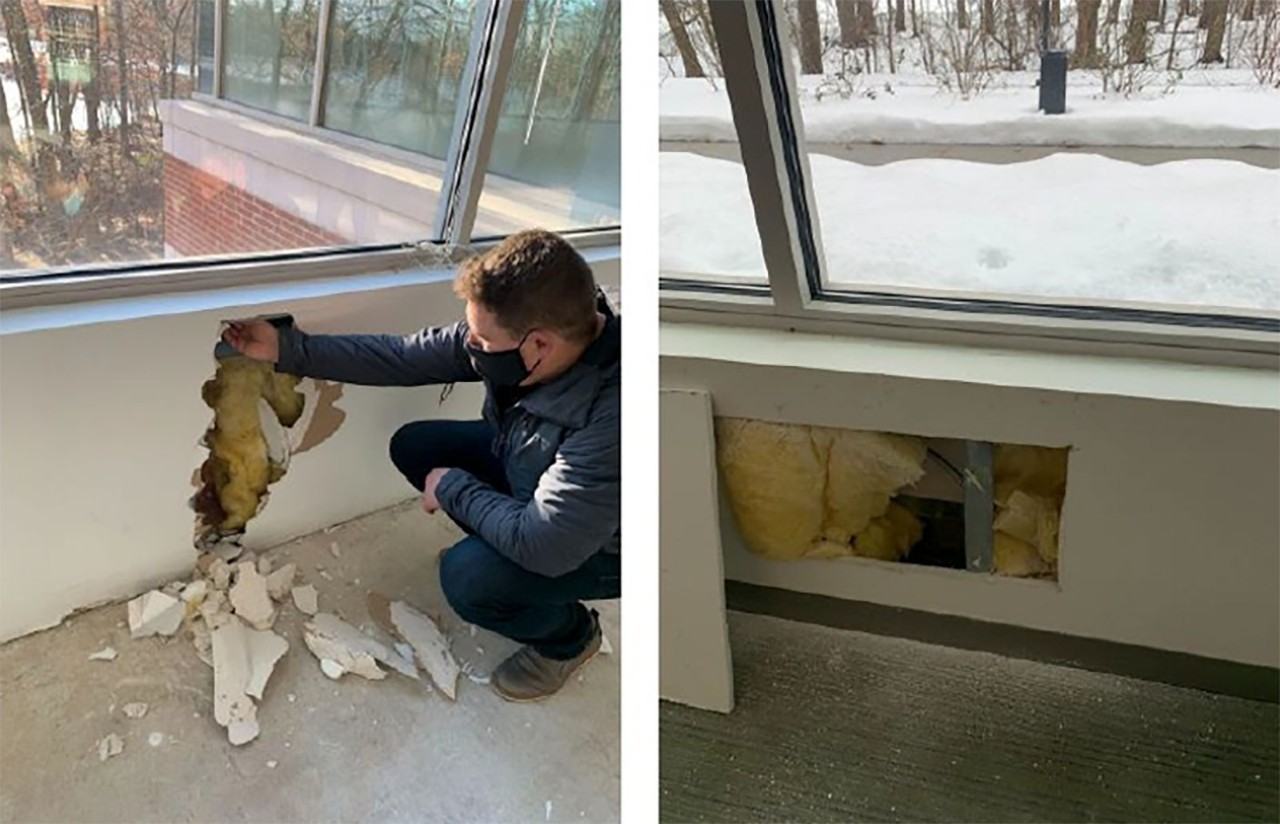
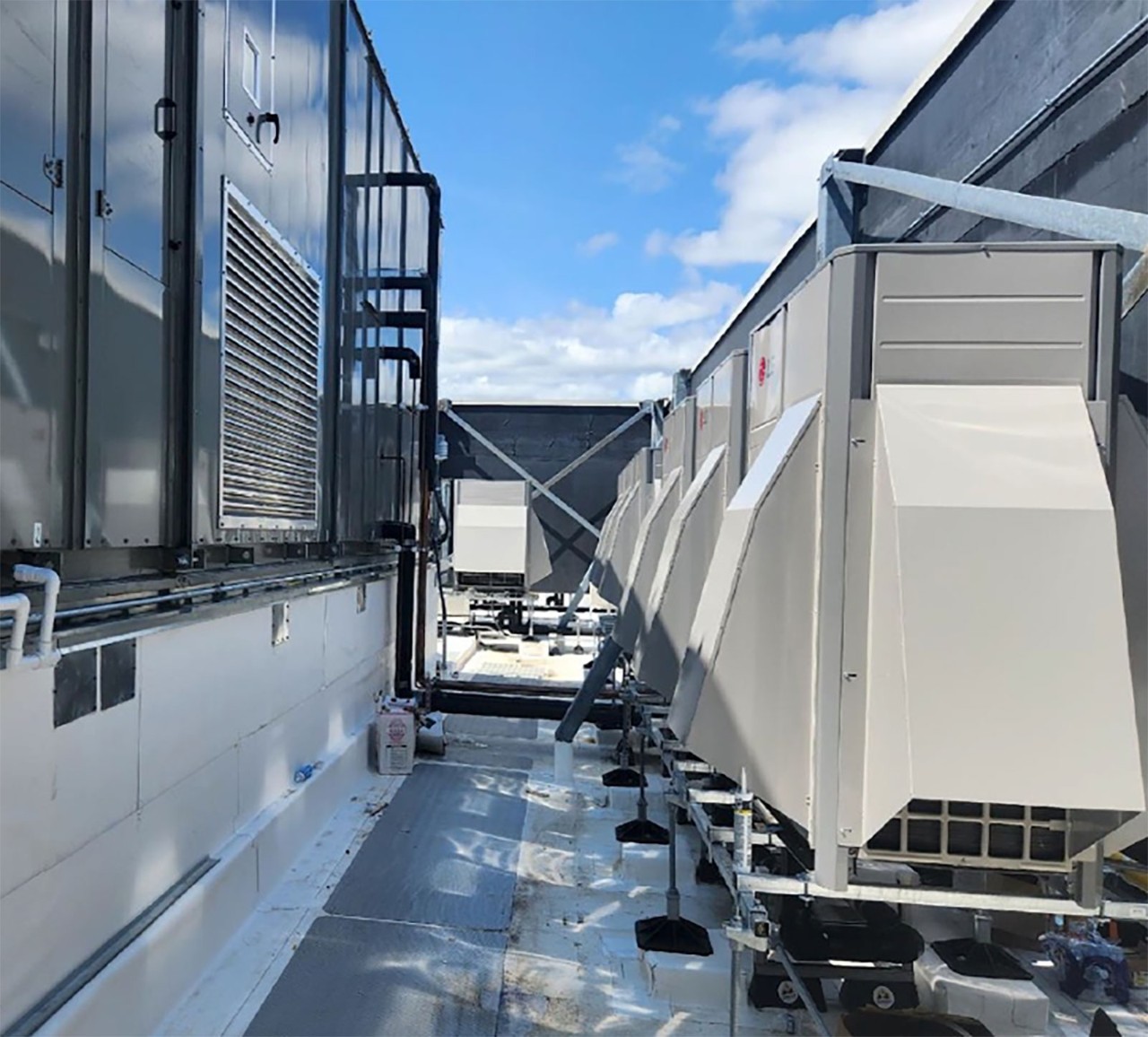
<p>On the mechanical side, natural gas systems were out. All-electric variable refrigerant flow (VRF) systems went in, along with energy recovery units to handle the temperature swings of New England winters and humid summers. The natural gas meter was removed entirely. The building, quite literally, started over.</p>
<p>But getting to net zero is not just about better HVAC systems and foam. It is about performance that endures. So BXP layered in renewables, with solar on the roof and a solar canopy in the parking lot. Together, they are generating more than 1.5 million kilowatt hours per year. With battery storage onsite, the system doesn’t just offset consumption. It smooths its time of day use, which shields the building’s operations from peak pricing and grid volatility. Over time, that package is expected to avoid more than 20,500 metric tons of CO₂ over its lifetime.</p>
<p><span class="p-body">Then came the governance layer, and this may be the project’s real innovation.</span></p>
<p><span class="p-body">Net-zero was not a target declared in a press release. It was operationalized through a pro-active lease. The tenant agreed to plug load limits and to cap lighting power density. A shared controls platform was implemented. The landlord procured the power purchase agreement (PPA) and the tenant agreed to share real-time data. Transportation-related emissions were folded in as well.</span></p>
<p><span class="p-body">Submetering went down to the equipment level. Plug loads were monitored continuously. Air quality was tracked. An open access dashboard displayed live performance to building operators, tenants, and if needed, regulators or investors. Sustainability here was not certified once. It was proven daily.</span></p>
<p><span class="p-body">Of course, the retrofit wasn’t frictionless. Sourcing the right ultra-low GWP materials took time, and integrating the battery system with building load profiles required intense commissioning support. Older structural elements didn’t always align neatly with new insulation strategies. Some of the hardest lessons came in the form of construction surprises, delays, and awkward fits.</span></p>
<p><span class="p-body">Still, that friction revealed something useful. Every complication exposed a blind spot that could be fixed. And every fix made the next project smarter.</span></p>
<p><span class="p-body">What emerged was not a perfect building. Rather, Boston Properties gained a repeatable blueprint.</span></p>
<p><span class="p-body">If the early 2000s gave us LEED as a brand, projects like 140 Kendrick are giving us performance as a baseline. The building doesn’t live on aesthetics or intention. It lives on data. And it reflects a deeper shift now rippling across the industry. Tenants, investors, and regulators are no longer asking about the specifications of what you built. They are asking how the building is performing in real time.</span></p>
<p><span class="p-body">The lesson? Retrofit isn’t a compromise. It’s the main event. If you can align performance with lease terms, if you can embed carbon savings into every specification, and if you can prove it live, you are not just hitting targets. You are changing the game.</span></p>
<p><span class="p-body">And that’s the real story of 140 Kendrick. How in a suburban market (as opposed to a plush luxury urban skyline), an older shell was converted tapping intention, precision, and shared responsibility. That means it can happen anywhere.</span></p>
<p><span class="p-body"><b>What Sidewalk Labs, Mighty Buildings, and UrbanBloc Tell Us About the Carbon Equation</b></span></p>
<p><span class="p-body">140 Kendrick offers a retrofit roadmap, proof that a second generation office shell can be turned into a performance asset. But the retrofit is just one path through the carbon maze. Elsewhere, other teams are redrawing the map entirely. Their work isn’t about fixing the old. It’s about rethinking the new. And each one reveals something critical about what it really takes to decarbonize buildings.</span></p>
<p><span class="p-body">Start with Sidewalk Labs in Toronto.</span></p>
<p><span class="p-body">At first glance, their proposal looked like a sustainability dream: a high-rise built almost entirely from mass timber, creating a skyscraper as a carbon sink, not a carbon bomb. Trees pull carbon from the atmosphere. Engineered wood locks it in. Stack enough of it vertically, and you’ve rewritten the blueprint of the modern tower.</span></p>
<p><span class="p-body">But ambition ran into inertia. Insurance providers balked. Local codes couldn’t keep up. Even with fire testing and engineering models in hand, regulatory systems weren’t ready to bless a wood tower of that scale.</span></p>
<p><span class="p-body">This is the paradox of innovation in real estate. Sometimes the building isn’t the problem. The system around it is.</span></p>
<p><span class="p-body">Then there’s Mighty Buildings, based in California, which is boldly 3D printing modular homes out of a proprietary low carbon composite stone. The construction involves no drywall, no rebar, not any formwork. The 3D modular paradigm requires just a printer, a design file, and a timeline that runs weeks instead of months. By manufacturing off-site and assembling on location, Mighty Buildings is slashing labor costs, reducing emissions from transportation, and cutting material waste to near-zero.</span></p>
<p><span class="p-body">If the old model was build-on-site, this new approach is closer to product manufacturing. It is housing, made like a Tesla with precision-designed, factory-controlled building, delivered with a carbon footprint you can easily audited.</span></p>
<p><span class="p-body">But innovation doesn’t eliminate friction. It just moves it.</span></p>
<p><span class="p-body">It’s not the printer holding back the rollout. It’s legacy permitting systems, labor skepticism, and neighborhood politics. The same innovation that makes the product clean also makes it unfamiliar. And unfamiliar is hard to zone.</span></p>
<p><span class="p-body">Now look east, to Newark, New Jersey, where UrbanBloc is doing something radically simple.</span></p>
<p><span class="p-body">They are not printing buildings. They are repurposing them. Specifically, old shipping containers upcycled into retail pods, kitchens, and small format commercial spaces. These aren’t just “green” because they’re recycled. They’re carbon-efficient because they’re mobile modular, and durable. They’re built to be relocated, reused, and reimagined multiple times without demolition or waste. Their positioning involves no cranes or excavators or even a new concrete slab; it’s simply structural steel that’s already lived one life and is ready for another.</span></p>
<p><span class="p-body">And in creating recycled buildings, UrbanBloc is making a different kind of argument. One that’s less about technology and more about philosophy of circularity and what it looks like in the real world, not as a theory, but as a practice. No blueprint needed, just a loop.</span></p>
<p><span class="p-body">Each of these projects, Sidewalk, Mighty, and UrbanBloc, are pushing the carbon conversation in different directions. One is challenging what a high rise is made of. Another is reinventing how homes are manufactured. A third is asking whether small commercial spaces need to be buildings at all. Each of them hits resistance in different places, policy, permitting, and perception, but none of them back off the question that matters.</span></p>
<p><span class="p-body">Can we build differently <i>and</i> perform better?</span></p>
<p><span class="p-body">At 140 Kendrick, the answer was found through precision retrofitting, carbon-linked leasing, and real-time proof. At Sidewalk Labs, it was a material leap that policy couldn’t catch. At Mighty Buildings, it was speed and form fighting against inertia. At UrbanBloc, it was about refusing to tear down what could be reassembled.</span></p>
<p><span class="p-body">They all prove the same thing: carbon isn’t just about <i>what</i> we build. It’s about <i>how</i>. And whether that “how” holds up under pressure, under scrutiny, and over time.</span></p>
<p><span class="p-body">140 Kendrick set the bar. These projects show us where the field is expanding, and where it’s still being held back.</span></p>
<p><span class="p-body"><b>Field Guide: The Language of Carbon by Design</b></span></p>
<p><span class="p-body">You’re going to hear a lot of terms in this chapter and in the field. Some you know. Some you’ve heard in meetings and nodded politely. Some might sound like acronyms invented to confuse you. Let’s fix that. Here’s what you need to know, in plain English.</span></p>
<p><span class="p-body">Carbon by Design: This is not a feature. It is a mindset. It means thinking about carbon from day one, how it gets in, how to keep it out, and how to design everything around reducing it. Materials, systems, operations, and contracts all share the same throughline. Carbon.</span></p>
<p><span class="p-body">Operational Carbon: This is the stuff you use. The electricity, the heating, the cooling, the servers. Every time you flip a switch or boot up a system, you’re tapping into operational carbon.</span></p>
<p><span class="p-body">Embodied Carbon: This is the stuff you buy. The steel, the concrete, the insulation. It’s the carbon footprint baked into your building before anyone even moves in. Once it’s in, it’s in.</span></p>
<p><span class="p-body">kBTU/sf/year: This is your building’s energy GPA. It tells you how many thousand BTUs of energy you’re burning per square foot, per year. Lower is better.</span></p>
<p><span class="p-body">Energy Use Intensity (EUI): Same idea, different name. This is the go-to metric for benchmarking energy performance. Think of it as your building’s fuel efficiency score.</span></p>
<p><span class="p-body">Mass Timber / Engineered Wood: Wood, but smarter. Cross laminated and glue laminated, designed to store carbon and support serious structural loads. It is not just for cabins anymore.</span></p>
<p><span class="p-body">Low-Carbon Concrete: Cement is carbon-heavy. This is the industry’s answer: mix in other stuff like fly ash or slag and suddenly concrete becomes less of a climate villain.</span></p>
<p><span class="p-body">Low-GWP Insulation: Foam that does not fry the planet. These insulations use less damaging blowing agents and still keep your building warm or cool.</span></p>
<p><span class="p-body">Carbon-Linked Lease: A new kind of lease where landlords and tenants both have skin in the carbon game. Use too much? You pay. Stay efficient? You both win.</span></p>
<p><span class="p-body">Building Performance Standard (BPS): Not a certificate. A law. If your building doesn’t meet the standard, there are consequences. This is where “nice-to-have” becomes “must-comply.”</span></p>
<p><span class="p-body">Local Law 97: New York’s wake-up call. If your building is big and inefficient, expect penalties. It’s the most aggressive emissions law in any major U.S. city right now.</span></p>
<p><span class="p-body">Energy Label C (Netherlands): In the Netherlands, if your office doesn’t hit this minimum energy score, you can’t lease it. Not figuratively. Legally.</span></p>
<p><span class="p-body">Submetering: Who used what, and when? Submeters track energy down to the circuit. You want accountability? Start here.</span></p>
<p><span class="p-body">Real-Time Emissions Dashboard: Think of this as the building’s live carbon score. It’s not a report once a year. It’s performance, every second.</span></p>
<p><span class="p-body">EC3: A free tool that helps you compare the embodied carbon in different materials. Useful if you’re trying to spec smarter, not just cheaper.</span></p>
<p><span class="p-body">Tally: Another software tool. Plug it into your BIM model and see the carbon footprint of your entire building design. It’s carbon counting with a designer’s eye.</span></p>
<p><span class="p-body">Net-Zero Ready: It means your building is efficient enough to go fully renewable, even if the panels or systems are not installed yet. It is the prep work before the payoff.</span></p>
<p><span class="p-body">Thermal Bridging: Heat slipping through the cracks, literally. Steel beams, poorly sealed windows, and structural connections that bypass insulation all leak energy.</span></p>
<p><span class="p-body">Building Envelope: The skin of the building. If it’s tight, your HVAC doesn’t work overtime. If it’s loose, your energy bills spike.</span></p>
<p><span class="p-body">Energy Recovery Ventilation (ERV): A system that trades stale indoor air for fresh outdoor air while capturing the energy in the process. Think of it as ventilation with brains.</span></p>
<p><span class="p-body">Power Purchase Agreement (PPA): You do not buy the solar panels. You buy the power they generate, at a fixed, usually cheaper rate. Clean energy, without the capital hit.</span></p>
<p><span class="p-body">Battery Storage System: Solar is great, but what happens when the sun goes down? Batteries store that excess power for later. It’s how you make renewables dependable.</span></p>
<p><span class="p-body"><b>References</b></span></p>
<p><span class="p-body"><sup>1 </sup>UN DESA World Urbanization Prospects: 2025: Summary of Results. United Nations Department of Economic and Social Affairs, population division.<a href="https://www.un.org/en/desa/latest-urbanization-data-reveal-world%E2%80%99s-most-populous-cities#:~:text=1%20December%202025%20%E2%80%93%20Our%20world,surpass%20the%2010%20million%20mark" target="_blank"> https://www.un.org/en/desa/latest-urbanization-data-reveal-world’s-most-populous-cities#:~:text=1%20December%202025%20–%20Our%20world,surpass%20the%2010%20million%20mark</a>.</span></p>
<p><span class="p-body"><sup>2 </sup><a href="https://www.iea.org/energy-system/buildings" target="_blank">https://www.iea.org/energy-system/buildings</a></span></p>
<p><span class="p-body"><sup>3 </sup>U. Berardi, Clarifying the new interpretations of the concept of sustainable building, Sustain. Cities Soc. 8 (2013) 72–78, <a href="https://doi.org/10.1016/j.scs.2013.01.008" target="_blank">https://doi.org/10.1016/j.scs.2013.01.008</a>, 2013/10/01/.</span></p>
<p><span class="p-body"><sup>4</sup> Ibid</span></p>
<p><span class="p-body"><sup>5</sup> Tagamud Tazmeen and Fasil Qayoom Mir, Sustainability through materials: A review of green options in construction. Results in Surface and Interfaces. 14 (2024) </span></p>
<p><span class="p-body"><sup>6</sup> <a href="https://www.usgbc.org/articles/7-green-building-products-explore-2024" target="_blank">https://www.usgbc.org/articles/7-green-building-products-explore-2024</a></span></p>