
<p><span class="p-body"><b><i><span class="p-body-large">Introduction</span></i></b></span></p>
<p><span class="p-body">The global energy system is undergoing a profound transformation, reshaped by growing electricity demand, rapid digitization, and a push to cleaner forms of energy. Artificial intelligence is emerging as a critical tool across the energy sector, reshaping how we plan and operate critical infrastructure. Meeting the moment will require a specialized workforce with the new skills to design, operate, and manage increasingly complex, innovative energy systems. Yet, despite the clear need, the pipeline of trained professionals has not kept pace with industry demand, creating a widening gap between workforce capacity and the digital fluency and systems thinking that will be essential to ensuring energy reliability, affordability, and environmental performance in the coming decades.</span></p>
<p><span class="p-body">Already, growth in demand for workers with an understanding of electricity infrastructure and markets, the clean energy transition, and associated “green” skills has outpaced the supply of available skilled workforce talent in recent years. In its end of year 2024 Future of Energy Survey, Ernst & Young found that 92 percent of energy executives, including power and utility as well as oil and gas executives, had plans to invest in digital technologies but only 27 percent were currently engaged in related retraining and reskilling programs, even though the executives agreed that their organization’s ability to reskill its workforce would be critical to future success.<sup>1</sup></span></p>
<p><span class="p-body">The pressing need for a skilled energy workforce is all the more critical, given this expected rise in U.S. electricity demand driven by expanding data center and manufacturing industries in the United States. Data centers consumed 176 TWh of electricity in 2023, representing 4.4% of total U.S. electricity consumption, according to the U.S. Department of Energy’s 2024 Report on U.S. Data Center Energy Use.<sup>2</sup> DOE projects this demand could increase to between 325 and 580 TWh over the next three years, the equivalent of about 7 percent to 12 percent of total U.S. electricity consumption by 2028. Consultants Wood Mackenzie estimate that data center infrastructure has been growing rapidly at about 10-20% annually in recent years, with an estimated 134 GW of new data center-driven electricity demand announced for this year, up from 50 GW in 2024.</span></p>
<p><span class="p-body">The gap between rising electricity demand and trained workforce is expected to become more pronounced in the coming years, especially as newly proposed renewable energy projects and advanced nuclear facilities reach their final investment decision. Digital job platform LinkedIn reported last year that there is a widening gap between the demand for green skills and available talent. In its 2024 Global Climate Talent Stocktake, LinkedIn revealed the number of job postings requiring green skills increased by 11.6 percent, while the supply of green talent grew by only 5.6 percent. By 2050, the gap between demand and the available workforce is projected to reach a staggering 101 percent.<sup>3</sup> Renewable energy-related jobs stood at 16.2 million in 2023, according to the most recent statistics compiled by IRENA, the International Renewable Energy Agency.<sup>4</sup> Similarly, the US Bureau of Labor Statistics also forecasts that US renewable energy industry employment will grow by 3.7 percent by 2035.<sup>5</sup></span></p>
<p><span class="p-body">Rapid advances in energy technologies mean that the energy workforce will need to be continuously upskilled and evolving. New technologies such as AI and robotic process automation are poised to transform an estimated 1.1 billion jobs over the next decade, according to the OECD, with many different applications that will impact energy infrastructure design and construction, systems management and automation, operation and maintenance, and forecasting and analytics.<sup>6</sup> The increase in decentralized electricity solutions for residential, commercial, and transportation networks is also increasing the demand for skills related to equipment installation and maintenance, as well as community engagement and customer service.</span></p>
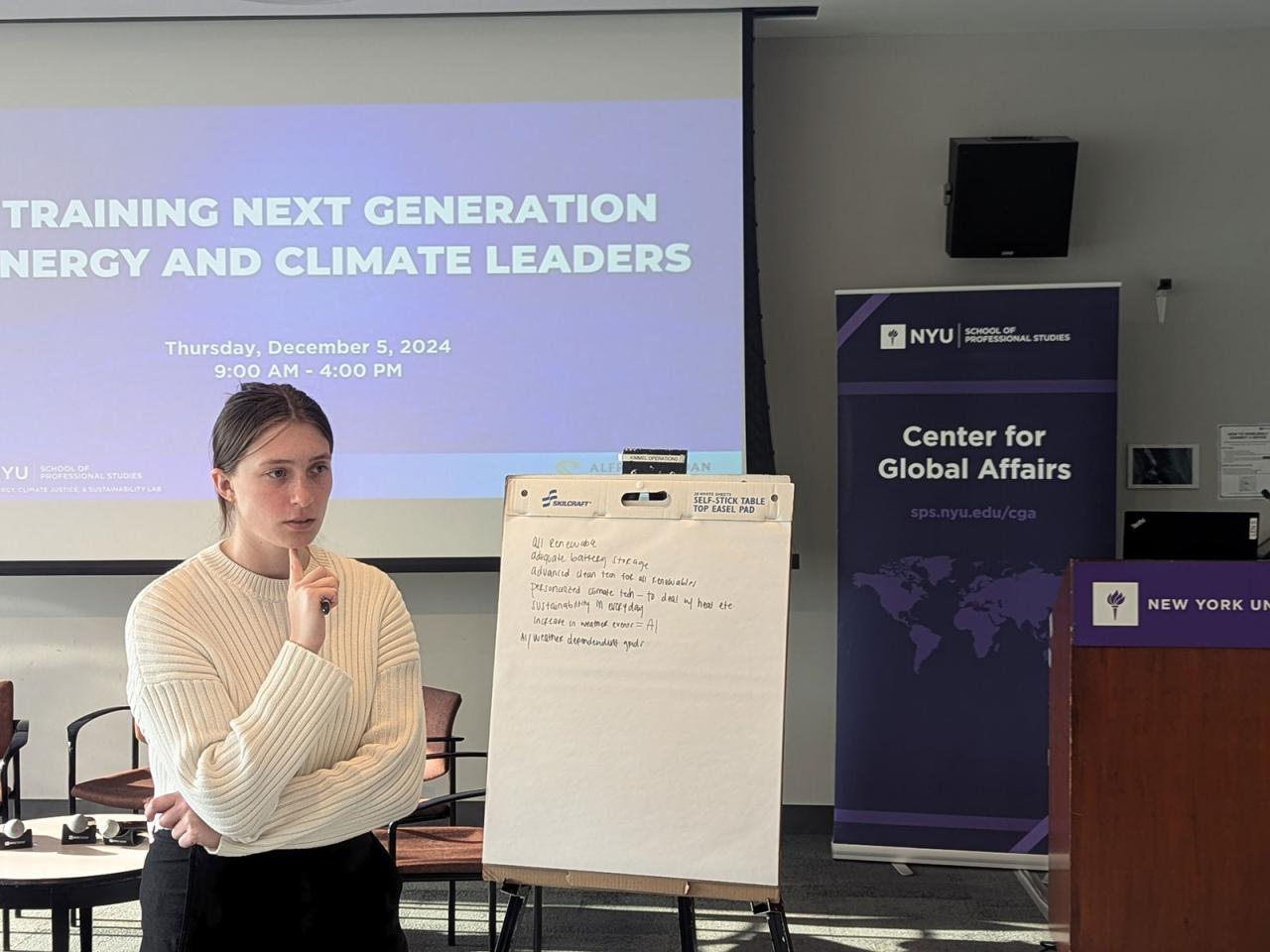
<p><span class="p-body">To explore these interactions between emerging technologies, the education system, and energy system decarbonization in more detail, in late 2024, NYU SPS Energy, Climate Justice and Sustainability Lab brought together leaders from K-12 education, higher education, community-based organizations and philanthropies, local government, and the private sector to build scenario storylines about the intersection of energy transition and related workforce development. This white paper reflects upon some of the key topics that were discussed to address the gap in training for the future energy workforce, including 1) modeling, data, and AI curriculum and training, 2) internal corporate upskilling, 3) experiential learning tools and programs, and 4) online instruction and free online resources.</span></p>
<p><span class="p-body"><i>Four Scenarios for the Energy Future</i></span></p>
<p><span class="p-body">During the workshop, participants identified key possible influences that might occur over the next five to ten years. Participants considered qualitative factors that fall within seven general categories of events, circumstances, and influences that could, in all likelihood, adjust market trajectories over time. The seven categories included: <i>technological breakthroughs, socio-cultural discontinuities, behavioral change, policy or regulatory trends, geopolitical influences, environmental factors, and economic factors.</i> Several key influences and uncertainties were identified during the discussion, including</span></p>
<ol class="p-list">
<li><span class="p-body">regulatory uncertainty</span></li>
<li><span class="p-body">falling technology costs for wind, solar, batteries, and electric vehicles</span></li>
<li><span class="p-body">rising commercial interest in clean and firm energy resources such as geothermal, long-duration storage, and advanced nuclear power.</span></li>
</ol>
<p><span class="p-body">Artificial intelligence and its potential use cases for energy education and technical training, as well as energy-related applications for automation and machine learning, were a continuous thread throughout the discussion.</span></p>
<p><span class="p-body">Generally, participants forecast an expected reduction in global trade and increased emphasis on domestic energy security over the next five to ten years. The U.S.-China strategic rivalry was highlighted as a continuing backdrop to geopolitical developments, while at the local level, priority for communities is likely to be emergency preparation and adaptation to more extreme weather. In discussing educational trends, participating students agreed that they increasingly seek out information online. Video materials, including video ‘how-to’ demonstrations, rather than large language models, were cited as most frequently guiding their learning.</span></p>
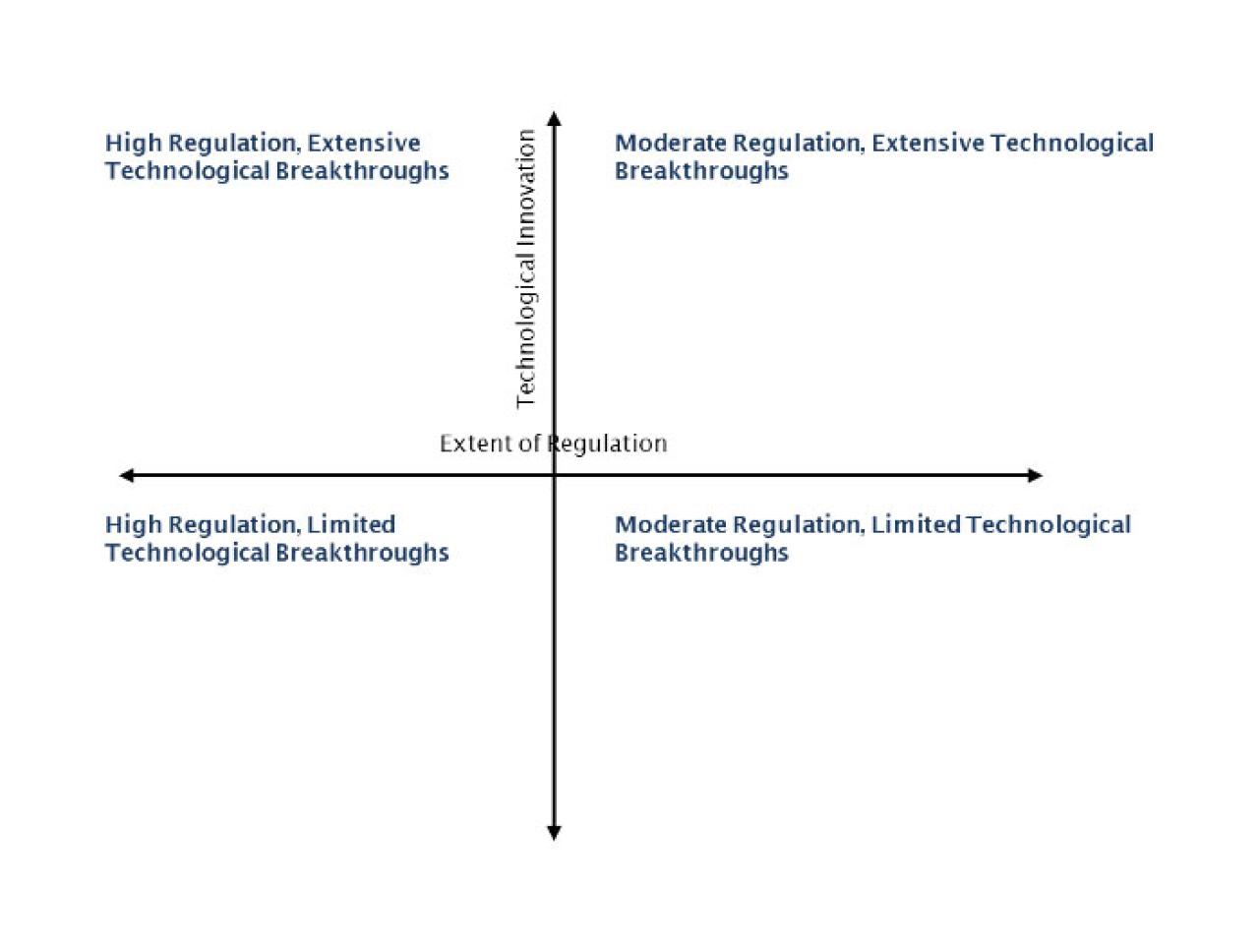
<p><span class="p-body">To further define the workshop scenario storyline exercise, workshop participants were given a matrix setting out different boundary conditions to consider related to the degree of technology innovation and stringency of regulatory conditions. Four groups were created and assigned to one of these four quadrants diagrammed below to use as the core theme and parameters for their scenario construction.</span></p>
<p><span class="p-body">With these influences and parameters in mind, the following four scenarios were created and presented.</span></p>
<p><span class="p-body"><i><span class="p-body-large">Scenario Storyline Summaries</span></i></span></p>
<p><span class="p-body"><b>1. American Backtrack (high tech, moderating energy transition)<br>
</b>In this scenario, the United States exits the global race to lead in clean technology and the country solidifies its emphasis on oil and gas businesses, especially exporting liquefied natural gas. Clean tech investment dollars dry up in the U.S., and investment dollars outflow to China, India, the European Union, and middle economies of the Global South. The Ukraine-Russia conflict continues to escalate, and sabotage and cyberattacks against energy infrastructure become more frequent in Europe. While the U.S. hastens approvals for new LNG export terminals, European consumers shift increasingly to distributed energy systems that are harder for Russia to threaten. Nuclear energy finds a renaissance on both sides of the Atlantic as an additional supplement to power new large loads like data centers and manufacturing. The pivot away from clean tech research reduces the number of international students coming to the United States for advanced degrees in energy technology and policy. For American students, energy systems science becomes a desirable course for study, as more jobs open for professionals who can assist business and policy leaders in planning ways to integrate renewable energy, automation, and digital technologies alongside existing legacy oil and gas infrastructure.</span></p>
<p><span class="p-body"><b>2. Generational Momentum (high tech, accelerating energy transition)<br>
</b>Local elections and social activism by Gen Z and younger populations help build momentum for sustainability as a driving force in business and higher education. The pressure to consider environmental and social impacts of energy and mining development creates tensions with other goals surrounding the rapid ascension of artificial intelligence, which is driving increased energy demand and pushing electricity prices higher for residential households. Electricity becomes a more politicized commodity. As a result, hyperscalers and other AI providers must navigate difficult technical and social challenges to simultaneously preserve access to the grid for expanding operations while at the same time tapping low-carbon energy sources and usage flexibility and energy efficiency. Maintaining a sustainability profile for AI operations is a key metric required to both preserve the right to operate as well as the ability to attract and retain top talent for America’s largest tech firms. Where fossil fuels are necessary to keep things running, more data firms are piloting carbon sequestration technologies and advanced micro-nuclear facilities, while continuing to support the energy transition to renewable energy and storage solutions. Energy-related education programs become more focused on AI, large language tools, and machine learning best practices, and virtual course and degree offerings become more popular.</span></p>
<p><span class="p-body"><b>3. Climate Unabated (low tech, moderating energy transition)<br>
</b>The artificial intelligence buildout pushes aside concerns about climate change, and the full steam ahead, no holds barred approach to AI eventually leads, ironically, to a collapse of rapid adoption of the technology as unintended negative consequences pile up and negative outcomes and bad publicity turn companies and individuals against AI’s widespread use. Still, in its early phase of AI infrastructure buildout, related energy infrastructure construction became fully depoliticized in the process, with no government subsidies on offer anymore to any form of energy fuel or technology. With no effective climate policy limiting greenhouse gas emissions, extreme weather worsens. Increased frequency and intensity of storms, heat waves, and droughts create serious reliability challenges for the utility industry. This challenge leads to more private sector adaptation initiatives, including more investment in technology innovation for new materials, backup systems, and grid management systems. Nature-based solutions to carbon removal and coastal protection gain new momentum, and climate tech investment moves into a new renaissance, driven by the private sector and increased opportunities for adaptation solutions. Educational institutions respond to increased interest in STEM-trained candidates by beefing up engineering schools and climate tech incubators, based on greater collaborations with the private sector.</span></p>
<p><span class="p-body"><b>4. Democratization of Energy Tech (low tech, rapid energy transition)<br>
</b>Massive government deficits lead to fewer federal dollars being spent on clean technology and nuclear R&D, but grassroots support for existing clean technologies grows, as the prices for electric vehicles, solar panels, and batteries drop substantially due to manufacturing overcapacity and falling costs of production in places like China and other parts of Asia. Consumers gravitate to increasingly accessible home system solutions such as plug-and-play portable solar panels, bi-directionally-charging electric vehicles, and smart thermostats, to lower energy costs. At the same time, community-based organizations and municipalities seek out improved electricity resilience and reliability in the face of increased weather-related outages. The result is greater installation of smaller-scale distributed energy systems and virtual power plant programs. The localization of mini-grid solutions creates more jobs for installers and skilled electricians, as well as programmers who can create software and smartphone tools for users of distributed power networks. Students seek out experiential work-study programs in communities to gain the tools and skills they need to participate actively in the energy transition. Universities respond by partnering with CBOs and municipalities where they are based, creating momentum from a corps of upskilled workforce that is learning in and outside the classroom.</span></p>
<p><span class="p-body">With these four possible trajectories in mind, this essay takes a deeper dive into the educational strategies that will be influential in delivering energy training and upskilling going forward. The essay considers educational approaches and tools that would be most resilient across the range of possible futures discussed during the scenario exercise.</span></p>
<p><span class="p-body"><i><span class="p-body-large">Challenges Ahead for Energy Education</span></i></span></p>
<p><span class="p-body">Characterization of the energy system across all four scenarios is notable for its forecast of increasing complexity of global, national, and even local energy networks. The level of technology expertise and training that will be needed for energy professionals and researchers to understand and work in these complex networks will intensify, with a broader understanding of multiple technologies required for systems design, installation, and operation. It is unlikely to be a one-size-fits-all energy solution going forward. Instead, bespoke solutions will reflect the resources availability and constraints in particular geographies, as well as local regulatory policy emphasis.</span></p>
<p><span class="p-body">For higher education, a key feature of energy education going forward will be integrating artificial intelligence and machine learning into energy analytics and systems design. Artificial intelligence’s far-reaching capabilities promise to revolutionize energy systems generally by reducing the costs and time to optimize operations, maintenance, and innovation. In the educational setting, large language models (LLMs) and artificial intelligence are increasingly being used to answer complex, cross-disciplinary questions, requiring students to be familiar with all aspects of the different kinds of data, pattern recognition, and coding that go into research efforts.</span></p>
<p><span class="p-body">Across the electricity system, AI has many applications already coming into view, including optimization of renewable energy; acceleration of transmission planning and generation asset siting and permitting; and facilitation of dynamic line rating for optimizing long-distance electricity transmission.</span></p>
<p><span class="p-body">For renewable energy, AI is assisting energy developers to speed up planning and deployment for utility-scale projects by improving algorithms for modeling the intersection of geo-specific weather patterns, available solar radiation, and wind speeds, and existing and future grid constraints. AI is also helping developers with the selection of the most optimal and cost-effective equipment type per site-specific conditions and constraints. In addition, large language models (LLMs) are being used to extract information from historical, successful permit applications and decision-making to allow developers to speed up their application processes. Conversely, LLMs can assist permitting authorities to more quickly review environmental and siting particularities as well as more efficiently consider alternating current optimal power flow (OPF) issues, speeding the transmission permitting process.<sup>7</sup></span></p>
<p><span class="p-body">AI is also increasingly playing a critical role in managing end-use devices and electricity storage, allowing demand management and storage aggregation companies and electric utilities to leverage large quantities of usage data to foster performance gains and facilitate time of day pricing and load management. AI is expected to be an enabler of bi-directional vehicle to grid or vehicle to home services.<sup>8</sup> In such systems, AI-enabled building management systems are programmed to charge batteries when electricity demand is lowest and external electricity prices are low. Customers who enroll in demand management programs are often compensated to have the same AI-enabled automation discharge their batteries during peak early evening hours when demand on the wider grid is highest, and solar energy is fading. The batteries are then recharged overnight to be ready for the next day. Such onsite AI-managed automated solar and battery systems can reduce the amount of traditional, large scale non-renewable energy needed, lowering emissions to the wider electricity system.</span></p>
<p><span class="p-body">Finally, AI is developing as an essential tool in the management of energy for buildings. As large commercial and residential buildings upgrade to automated digital management systems, AI is being utilized to manage energy use and lower operational costs.<sup>9</sup> For new builds, architects and developers are designing “circular” buildings which generate their own energy onsite, mainly renewable resources like solar and site specific geothermal. Onsite geothermal systems often utilize water filled pipes to collect steady geothermal heat underground below the building to move the heat in the form of hot water from underground into a radiant heating system under floors. For cooling, heat pumps on the roof can remove heat and send cooled water back through the building. These new kinds of systems mean that building managers and technicians need to upskill into electronics and IT functions to keep systems operating smoothly and to make repairs when needed.</span></p>
<p><span class="p-body">These and other emerging AI applications for energy systems management presents new challenges and opportunities for high education. The level of knowledge of emerging energy production and distribution systems has mushroomed and now requires a broader understanding of multiple technologies and an expanding array of different technical solutions. In academia, the overriding traditional organization around siloed research and education fields of specialization (chemical, mechanical, and electrical engineering, economics, finance, policy studies, sociology, etc.) creates barriers for students to attain the wider range of skills and knowledge that is now required post-graduation. Even technical knowledge needs to span a wider array of disciplines since technology design and innovation increasingly defies traditional boundaries of chemical, mechanical, electrical, and power engineering and other areas such as materials science, computer science, statistics, and digital programming.</span></p>
<p><span class="p-body">As large language models (LLMs) and artificial intelligence become more ubiquitous tools for answering complex, cross disciplinary questions related to energy, college students will need to attain a wider range of analytical skills and core technical knowledge to be effective. In other words, the increased complexity in the energy system means universities need to restructure learning in a way that students are not limited to modeling techniques that are presented by a singular home department such as engineering, economics, or business.</span></p>
<p><span class="p-body">In many university-based energy programs today, students are segregated into divisional home departments whose courses are typically designed to tackle energy analytics with tools limited by their discipline, for example: financial modeling in business schools; integrated assessment models in energy systems engineering; general equilibrium integrated energy-economy models in economics; network analysis in computer science; and production cost optimization models for power dispatch solutions in electrical engineering. Some questions related to future energy systems and technology integration and innovation would be best answered using a combination of these approaches. And, with tools such as LLMs available to help students tap open-sourced information to implement coding related to model creation, methods of teaching need to be updated.</span></p>
<p><span class="p-body">Fodstad et al., 2022 surveys the challenges of multi-carrier (or multi-fuel), multi-sector energy modeling that is required to study the current complexities of the energy system and the changes it is undergoing.<sup>10</sup> The study notes specifically “The implementation of an effective energy transition plan faces multiple challenges, spanning from the integration of the operations of different energy carriers and sectors to the consideration of multiple spatial and temporal resolutions.”<sup>11</sup> The authors note that demand side issues, and in particular, the advent of prosumer participation (e.g. consumers who can produce and resell their own energy sources) has made modeling energy consumer behavior particularly difficult.</span></p>
<p><span class="p-body">Capturing the uncertainty about the time scale for scale up of emerging technologies has been another large challenge to incorporate into energy models correctly. Moreover, the time scale for balancing supply and demand in electricity is different from the traditional liquid or gaseous fuels it may be replacing such as natural gas, diesel, or gasoline, which are more easily stored and stockpiled ahead of use to smooth out disparities in timing of deliveries versus timing of end use. By contrast, historically, electricity supply and demand generally needed to be calibrated to remain balanced all the times to regulate system voltage stability at the desired operational level. Now, as electricity storage technology itself is evolving, the time scale for balancing supply with demand in electricity is changing, posing new opportunities for systems design. Incorporating these changes into energy modeling requires new, updated methodologies to capture the complexity of flows throughout a more diverse set of equipment in the distribution system.</span></p>
<p><span class="p-body">Another key challenge for academic research in energy modeling is the increasing digital access-divide to critical data. Much of the important data on specific utility operations, consumer usage patterns, or time of day usage patterns is most often proprietary and not publicly available. Much of the useful data on energy systems operations sits behind the curtain of major players such as utilities, electricity systems operators, technology companies, and fuel distributors. Even when data is made public, it is often incomplete or unavailable in the necessary spatial or temporal detail that would be most useful.</span></p>
<p><span class="p-body">For publicly available data, as energy technologies evolve, researchers face challenges related to inaccuracies or outdated information. Moreover, the process of verifying and improving the quality of the data is becoming more difficult. Data is often available in formats that require conversion or manipulation and as the data becomes more complex and larger, it will be harder to clean the data or evaluate the documentation that goes with it. Harmonization of data from across different types of energy providers, regions, and sectors adds to the complexity of constructing comprehensive integrated models or useful comparative data platforms. The computational requirements of processing large data sets and running complex models require significant time and resources, including access to powerful computing infrastructure, another potential barrier to individual scholars.</span></p>
<p><span class="p-body">One of the most challenging aspects to managing the future of energy modeling and training in higher education is likely to be the need for increased data sharing and transparency from private industry and from utilities, in particular. Often, private sector energy companies take the position that the data is proprietary to their businesses and similarly raise privacy issues for data related to consumer usage patterns. Moreover, increasingly, data is being collected by hyperscaler firms, who have launched energy divisions that specialize in distributed energy systems (DERs) or consumer usage products like smart thermostats or home management systems. Again, these firms use the data they collect from users of their products to train AI and create other additional products that generate commercial value, creating an incentive to cordon off the data away from educational uses. The latter trend has increased the advent of upskilling programs that are held within companies for current employees instead of through institutions of higher learning.</span></p>
<p><span class="p-body">To address the need for rising numbers of trained energy professionals, many universities and colleges around the country are working to build out the necessary infrastructure of energy and sustainability centers. At present, secure funding for newly minted PhDs, who will contribute to those research centers and remain in academia to teach the next generation and advance clean energy education, is not currently prioritized for public funding, leaving open the question of how to finance the training of the next generation of energy faculty going forward. Universities will have to consider new models for funding PhD candidates as heavy reliance on institutions such as the U.S. National Science Foundation (NSF) and the U.S. Department of Energy has proven challenging for some programs over the past year. Several universities, notably Stanford University, the University of Chicago, and Princeton University, have had energy and climate centers endowed by distinguished alumni with ties to the energy sector. While these philanthropic endowments are empowering expanded research and educational activities, they risk skewing efforts to a particular narrow focus of benefactor interest if they are not negotiated thoughtfully.</span></p>
<p><span class="p-body">The National Science Foundation currently encourages proposals that include industry interest and collaborations. More such partnering between the private sector and universities could be one avenue for closing the workforce gap and creating the frameworks for the sharing of proprietary private sector data with scholars and all levels of student researchers. The challenge is that university communities often worry about differing incentives between scholars and industry counterparts. Others have raised concerns that collaboration between industry and scholars could inadvertently or overtly promote uncomfortable compromises of academic freedom and independence. One solution is to build partnerships that involve consortia of many companies, including companies across different but related industries, to prevent any one company from trying to unduly influence research agendas or results. One benefit is that proprietary data from many participating industry partners can be aggregated, anonymized, and managed by university research leaders, allowing all involved parties, including the public, to benefit from research efforts and the creation of shared analytical tools. Still, in the case of the energy industry, moral questions have been raised related to the industry’s role in blocking climate policies at the political level or in producing misinformation about climate change, clean energy, or the costs or benefits of decarbonization. This requires a rebuilding of good faith, transparency, and governance for collaborations.</span></p>
<p><span class="p-body"><i><span class="p-body-large">The AI and Energy Training Gap</span></i></span></p>
<p><span class="p-body">As industry workforce requirements change - given the rapid evolution of new technologies and emerging fields such as the use of sophisticated computational modeling tools and remote sensing - many employers are struggling to find and retain employees with the skills to meet their business’ evolving needs. According to research from ManpowerGroup, the global workforce solutions company, roughly eight in ten organizations have sustainability strategies to address energy transition and advances in artificial intelligence, but the vast majority, over 94 percent, report they do not have the talent to implement their plans.<sup>12</sup><a href="#_ftn1" name="_ftnref1"></a></span></p>
<p><span class="p-body"><a href="#_ftn1" name="_ftnref1"></a>The question of how organizations will pivot to meet this need for technically upskilled talent is being asked across government, academia, philanthropies, and the private sector. In some key workforce roles, American labor unions are taking up the slack through apprenticeship training, but not all skills that will be needed can be achieved in this manner.</span></p>
<p><span class="p-body">Some tech-forward companies are choosing to manage upskilling internally, like Amazon, which has trained thousands of employees through its internal Machine Learning University program. However, consultants BCG warn that only a quarter of firms are actively linking reskilling effort sand corporate strategy.<sup>13</sup> A World Economic Forum study further suggests that organizations that choose to reskill at least a fourth of their workforce to adjust to AI and automation technologies are far more likely than those that don’t integrate AI training to remain profitable by improving the quality of their workforce while simultaneously retaining institutional knowledge.<sup>14</sup> To successfully engage with AI applications, a workforce that has the requisite skills that utilize an understanding and use of data will be critical.</span></p>
<p><span class="p-body">Teaching with LLMs as a learning tool requires a new set of skills and knowledge related to prompt engineering and how to fortify student access to and knowledge of credible information sourcing for verification. Questions remain whether people who frequently use LLMs have worse critical thinking skills over time than those who don’t, a phenomenon called “offloading.” And using the LLM tools for research and problem solving also raises challenges related to the biases still embedded in the tools, as well as to AI’s proclivity to offer so-called “hallucinations” or disinformation or false responses that must be ferreted out.<sup>15</sup></span></p>
<p><span class="p-body">In the summer of 2025, I piloted an advanced summer colloquium on AI and Energy for MS students at New York University. One innovation for the class was my plan to use LLMs to complete both instructor-guided, in-class exercises as well as select take-home, graded research assignments. The exercises were crafted to mirror real-world analytics and research activities performed in current energy-related jobs. The level of energy background among the students was varied, and several students joining the colloquium had no prior experience using an LLM for degree-related courses or job-related work. My experience with the course reveals some interesting takeaways.</span></p>
<p><span class="p-body">First and foremost, LLMs often give different users divergent answers to the same prompts, even when there is a readily available factual answer. Imagine my surprise when eight of us asked the same LLM to summarize the key takeaway from Ethan Mollick’s book Co-Intelligence: Living and Working with AI, and we got markedly different answers. Students benefited from instruction on how to embed in their prompts what source material to require the LLM to use in answering the question, as well as a good set of follow-up up asking the AI to explain its assumptions and show its source material. In the case of Ethan Mollick’s book, the answer could be considered more subjective than, say, a query on the contents of a specific energy regulation or policy. Our seminar found that a follow-up prompt that asks the LLM to consider what Mollick himself said was the main takeaway from his book gave more consistent answers to all of us than our initial general question.</span></p>
<p><span class="p-body">In a different exercise where the class was asked to get an LLM to supply accurate data on permitting rules for solar energy development in a particular location in the United States, we enlisted an industry guest lecturer to coach students what prompts and follow-up queries energy professionals in the field use to refine results. The advantages of knowing the prompts used by experienced LLM-assisted researchers has become a business in and of itself with new websites, like Prompto.chat and Promptvine.com, providing guides to already programmed LLM queries for common research topics. Over the course of the class, it became clear that the students benefitted from having guidance from faculty and industry guest lecturers with topic specific knowledge to assist them in navigating the tool to generate a technically accurate answer.</span></p>
<p><span class="p-body">All this is to say that banning LLMs for classroom assignments seems like it could wind up as a disservice to students. A more effective instructional approach is to have energy students use the tool in class under direct instructor guidance, as a necessary counterweight to AI’s increasingly ubiquitous presence in our online LLM assisted research experiences. Helping students know when AI use can be productive and when it cannot is now a critical intellectual and analytical skill for the future workforce and a vital part of professional training in energy. There are certainly functions where a judicious use of AI can accelerate workflow and increase productivity. There are also complex computational problems in energy systems planning and materials innovation where AI is highly material to ensuring the best outcomes can be achieved promptly.</span></p>
<p><span class="p-body">The challenge is how to ensure that end-result solutions can be verified in a manner that fully ensures safe operations in the energy sector. Energy is an industry that requires precision in durability of materials and in operational standards, as well as in product specifications and standards for guaranteed physical and molecular properties and chemical compositions. Even small deviations can lead to dangerous results, including fire and explosions.</span></p>
<p><span class="p-body">As more data becomes accessible, mainly through LLMs, the problem becomes that accurate information and analysis can become harder to verify and retrieve. This reality increases the value of libraries, the private sector, and not-for-profit institutions holding physical books and segregated data as a future depository of knowledge, lest someday the AI algorithms so are disruptive to information accuracy that a place to do research separated and isolated from AI logic and AI tools is needed. The same might apply to corporate institutional knowledge, which is increasingly being digitized for use in custom internal copyright and patent-protected LLM tools. These custom LLMs may be such that energy companies might be well-advised to maintain some database or repository that is firewalled from the AI algorithms and the internet. Other guardrails and personnel upskilling are similarly needed inside energy companies with customized LLM data retrieval, workforce specialists suggest.</span></p>
<p><span class="p-body"><i><span class="p-body-large">Upskilling and Training on the Job</span></i></span></p>
<p><span class="p-body">The buildout of energy faculty in higher education faces an additional challenge from the fact that more flexibility is needed in the structure and nature of educational offerings and degree programs going forward. In today’s tech-driven economy, a large percentage of jobs require a post-secondary degree; yet for many learners, the traditional high school-to-college career pathway is no longer working, especially given the rising costs of higher education. According to the Census Bureau, more than 62 percent of Americans ages 25 and up do not hold Bachelor’s degrees, and the majority of this demographic—70 percent, according to the National Center for Educational Statistics—are considered nontraditional or post-traditional students (e.g., first-generation, low-income, military-affiliated, etc.).<sup>16</sup> In New York City, for example, only about a quarter of young people progress through traditional avenues to embark on professional, well-paying careers.</span></p>
<p><span class="p-body">Future workforce concerns have produced a growing recognition across industry sectors, including energy, about the critical value of apprenticeships and other experiential workplace learning opportunities. One often overlooked feature of integrating a larger base of upskilled workers into the energy workforce is the fact that family-sustaining jobs are paramount for many students, creating a need for more flexible “earn and learn” curriculum options that meet students where they are. Earn and learn programs should be designed to provide well-paying part- or full-time employment that couples college-credits for ongoing work experience and on-the-job training with employer-sanctioned opportunities to supplement this work-study with employee participation in college/university-based credit courses towards undergraduate and advanced degrees.</span></p>
<p><span class="p-body">As the energy industry competes for talent, many CEOs are finding that upskilling is a necessary and preferred way to address the current workforce shortages in the sector. In its annual survey of the energy, utilities, and resources industry, PwC found that C-suite leaders are prioritizing developing skills in data science and analytics within their organizations.<sup>17</sup> This is particularly true for the utility industry, which is pivoting towards a more customer-driven business, where they are having to add businesses that connect and integrate an increasingly decentralized energy system, rather than just construct and operate large-scale infrastructure.</span></p>
<p><span class="p-body">Many workers prefer to learn on the job, according to consultants BCG,<sup>18</sup> and benefit from programs that include shadowing assignments and job-filling for trial periods through vocational residencies or structured internal internships.</span></p>
<p><span class="p-body">One challenge for upskilling internally is that companies need to build a corporate culture that encourages employees to learn new skills and be resilient to change. This process begins with an inventory of current workforce capabilities and future needs in light of increased automation. Companies are increasingly turning to forecasting business growth and strategy into the number of people that will be needed in various jobs and what skills those jobs will require, with some companies using scenario planning to provide more insight. The inventory of workforce capabilities can also be utilized to offer personalized learning recommendations for workers who want to maximize their opportunities.<sup>19</sup> Digitization and AI-assisted systems can track the performance of employees against learning objectives and well-designed performance analytics to monitor learner progress and automatically adjust content through dynamic processes to meet the needs of personalized skill development.</span></p>
<p><span class="p-body">In the case of the energy industry, digital tools have already been widely integrated into workflow and training. Two specific technologies that are widely used include virtual reality for immersive, hands-on training and digital twin technologies, that is accurate virtual replicas of energy system equipment and devices. Both technologies allow trainees to practice complex tasks and real-world maintenance and other operational challenges in a controlled, risk-free environment.<sup>20</sup></span></p>
<p><span class="p-body">However, even as such important digital tools are integrated into day-to-day operations and training programs, problems still exist with the hidden use of AI by company employees and the security and business challenges that can arise as a result, especially for protecting the security of proprietary data. A Gallup poll of leading human resources/upskilling department professionals in large companies conducted in 2023 revealed that close to half of those leaders were not aware of when, why, or how frequently employees are choosing to tap AI resources to do their jobs.<sup>21</sup> The survey further identified a gap between a majority of employees who believed they were prepared to utilize AI tools to do their work and corporate management, human relations leadership, which may have assessed their workforce as not yet prepared.</span></p>
<p><span class="p-body">This perception gap mirrors higher education, where a growing divide is emerging between rising student capability in AI tools and the lower level of faculty instructor curriculum engagement that utilizes AI tools. As one major university administrator noted at the NYU seminar, “The AI future is already here. It’s just unevenly distributed.”</span></p>
<p><span class="p-body"><i><span class="p-body-large">Experiential Learning</span></i></span></p>
<p><span class="p-body">In the same manner as businesses that focus on in-house upskilling through shadowing, residencies, and internships, higher education institutions are adopting experiential learning to equip graduates with energy career-ready skills and improve learning outcomes amid evolving access to artificial intelligence. This includes energy courses and supplemental activities that emphasize service learning (that is, working in energy-related activities in local communities as part of their coursework), faculty-guided, project-based learning, global study abroad or field intensives, and work-integrated learning. Best practices suggest that students should be offered a structured, pre-orientation course materials to frame experiential learning for energy-related academic curricula that will meaningfully expose the student to themes and issues that will arise once in the field.<sup>22 </sup>Like regular courses, experiential learning experiences should be connected to learning outcomes that are measurable and assessed. Students benefit from a final presentation or written assignment that includes a personal reflection on specific learning and broader skills and analysis undertaken during the experiential endeavor. A 2023 student survey by Inside Higher Ed found that 43% of students were influenced in career choice via an experiential learning offering, while an additional 33% said the experience helped them “learn what tasks they enjoy.”<sup>23</sup></span></p>
<p><span class="p-body">Experiential learning as an element of teaching is ultimately an existential pivot for institutions of higher education because the traditional lecture and examinations style course structure that has served institutions for decades is no longer as attractive a value proposition for energy-related training, given the extensive access learners have today to free content via the internet. Still, well-designed experiential energy-related curricula can help students learn how best to apply their knowledge, rather than just be exposed to information. As discussed above in reference to the rising use of LLMs, students benefit from instruction on how to determine what data or information is most valuable or critical to analyzing specific energy-related questions of inquiry or finding solutions to critical societal or technical problems or challenges related to energy.</span></p>
<p><span class="p-body">However, one challenge to experientially-oriented learning for institutions of higher education, in general, is how to scale experiential learning to make it accessible to a large volume of students. One successful format is to pair traditional classroom learning with a practicum exercise involving external parties, such as government agencies, private sector companies or non-governmental organizations, who serve as “clients.” The external partner provides an energy problem or research question(s) that teams of students can investigate over the course of the semester.</span></p>
<p><span class="p-body">Final deliverables are designed both to be presented to faculty instructors for grading and feedback, but also ultimately presented to the underlying client entity for additional feedback and learning. The “clients”, in turn, get the benefit of both meeting students to potentially hire when they graduate and also gain actionable insights for the operation of their businesses or agencies. Practicum courses bring together students under the guidance of a faculty instructor to conduct research together on a topic(s) of interest to industry and government. These practicum courses, which focus on questions brought forward by the entity serving as the program's “client,” provide students with a unique opportunity to tackle real-world energy-related problems and challenges and consider innovative solutions and problem-solving. Through this style of hands-on learning, students can gain knowledge and targeted upskilling before they step into new roles in their professional careers. Practicum consulting projects are designed to help students learn to evaluate, compare, and reflect on technology innovation, new business models, and policy design.</span></p>
<p><span class="p-body"><i><span class="p-body-large">Other Kinds of Learning for Energy Professionals</span></i></span></p>
<p><span class="p-body">According to the Renewable Energy Learning Partnership (IRELP) global database, the most prevalent higher education energy courses are broad in focus and cover multiple renewable technologies instead of specializing in particular systems or fuels.<sup>24 </sup>According to the database, courses focused on solar energy represent the next largest category at about a fourth of all course offerings.<sup>25</sup> The highest share of renewable energy courses on offer globally is taught at the Master’s degree level (about a third of all courses), with professional development training following in second place. Roughly 10 percent of curricular offerings are online.<sup>26</sup> Vocational training represents about 15 percent of the share of renewable energy training offerings globally. North America dominates as the widest geography with specialized vocational and associate apprenticeship programming.<sup>27</sup></span></p>
<p><span class="p-body">Online learning is widely accepted in the broader energy industry, with industry associations such as the Society of Petroleum Engineers and Occupational Health and Safety Organization (OSHA) organizing online programs for industry professionals. Increasingly, similar associations in clean tech, such as the American Clean Power Association and the Solar Energy Industries Association, are offering online certified training programs for technicians and for developers and project managers. Many U.S. universities also offer online certificates for early and mid-career professionals in the energy field across a broad spectrum of topics.</span></p>
<p><span class="p-body">However, current research focused on student satisfaction and learning effectiveness for online courses has been mixed, with a handful of studies suggesting that online learning can produce lower completion and success rates, and others pointing to advantages such as self-paced learning, which provides gains for students who benefit from the convenience and flexibility.<sup>28</sup> For instance, an assessment of free “massive” open online courses offered by U.S. universities showed low retention and completion rates.<sup>29</sup></span></p>
<p><span class="p-body">Indeed, Gen Z is particularly noted for their self-directed learning from social media, where they are reported to spend up to 4.5 hours a day. As one recent study suggests, such learning exposes students to unverified information, and therefore, students can benefit from the integration of social media and digital learning technologies into curricula to help students learn to assess the credibility of information and apply critical thinking.<sup>30</sup></span></p>
<p><span class="p-body">The study also emphasized the benefits of collaborative learning, which is supported by other investigations regarding online learning. Indeed, one major takeaway from the body of research on the topic is that reduced social interaction associated with online learning is a key factor that reduces its effectiveness as an education methodology. This can be remedied by structuring courses to encourage joint assignments during class and non-class hours.<sup>31</sup></span></p>
<p><span class="p-body"><i><span class="p-body-large">Conclusion: A Call to Action</span></i></span></p>
<p><span class="p-body">The question of integration of AI into energy workforce education is no longer an “if” but a question of how best to implement. What’s needed is a direct effort to shape the coming transformation with intention, lest a haphazard approach lead to unintended, negative consequences. Energy professionals and students alike already live in a world where large language models and AI tools are part of their daily work and learning environments. The energy industry itself is already embracing digital technologies to manage the rising complexities of the widening mix of energy sources and technologies.</span></p>
<p><span class="p-body">What’s missing is an alignment of policy, education, and practice to ensure that the coming generation of energy professionals is trained to be active leaders in harnessing AI responsibly and ethically. Educators and policymakers need to act with urgency, establishing clean and transparent standards and guardrails for the use of AI in energy practice and education, ensuring that the energy workforce learns to use AI tools critically rather than blindly.</span></p>
<p><span class="p-body"><i><span class="p-body-large">Recommendations</span></i></span></p>
<p><span class="p-body">A. Treat digital literacy, prompt engineering, and AI ethics as core competencies in energy education curricula and in corporate upskilling programs, equal in importance to engineering principles or policy analysis.</span></p>
<p><span class="p-body">B. Foster cross-disciplinary energy degrees that integrate innovative energy market and systems modeling techniques that draw on best practices and technologies from a variety of academic disciplines.</span></p>
<p><span class="p-body">C. Embed experiential learning, internships, and/or vocational pathways into energy educational, training, and upskilling programs so that learners graduate with both knowledge and practice. Well-designed experiential curricula can help students learn how best to apply their knowledge, rather than just be exposed to energy-related knowledge and information.</span></p>
<p><span class="p-body">D. Enhance academic training and on-the-job training with digital resources such as virtual reality for immersive, hands-on training and digital twin technologies, that is accurate virtual replicas of energy system equipment and devices.</span></p>
<p><span class="p-body">E. Create paradigms where academia and industry can set up trusted data-sharing partnerships and consortia that empower research efforts without compromising academic integrity. Academic institutions should consider building partnerships that involve consortia of many companies, including companies across different but related industries, to prevent any one company from trying to unduly influence research agendas or results.</span></p>
<p><span class="p-body">F. Create private sector upskilling programs where learning on the job can take place via shadowing assignments and job-filling for trial periods through vocational residencies or structured internal internships.</span></p>
<p><span class="p-body">G. Establish National AI-Education baseline standards through collaboration between state agencies and accrediting bodies for AI use in energy education and research.</span></p>
<p><span class="p-body">H. Establish best practices and practice standards through collaboration between AI providers and energy industry associations for AI use in custom energy company operations and knowledge dissemination.</span></p>
<p><span class="p-body">I. Develop and maintain repositories of critical data and analysis firewalled away from LLM and other AI tools and separated from the internet to ensure the continuing integrity of backup data and inputs to ongoing energy systems learning, practice, and operations.</span></p>
<p><span class="p-body"> </span></p>
<p><span class="p-body"> </span></p>
<p><span class="p-body-small"><sup>1 </sup><a href="https://www.ey.com/en_us/energy-resources/ey-future-of-energy-survey">Future of Energy Survey</a><br>
<sup>2</sup> <a href="https://escholarship.org/uc/item/32d6m0d1" target="_blank">2024 United States Data Center Energy Usage Report</a><br>
<sup>3</sup> <a href="https://economicgraph.linkedin.com/content/dam/me/economicgraph/en-us/PDF/linkedIn-global-climate-talent-stocktake-sept-2024.pdf" target="_blank">Global Climate Talent Stocktake</a><br>
<sup>4</sup> <a href="https://www.irena.org/Data/View-data-by-topic/Benefits/Renewable-Energy-Employment-by-Country" target="_blank">Renewable Energy Employment by Country</a><br>
<sup>5</sup> <a href="https://www.bls.gov/news.release/pdf/ecopro.pdf#:~:text=Solar%252C%2520wind%252C%2520geothermal%252C%2520and%2520other%2520electric%2520power,combined%2520are%2520projected%2520to%2520add%252041%252C600%2520jobs" target="_blank">News Release - Bureau of Labor Statistics, U.S. Department of Labor</a><br>
<sup>6</sup> <a href="https://www.forbes.com/sites/johnhall/2023/02/24/why-upskilling-and-reskilling-are-essential-in-2023/?sh=606903d24088" target="_blank">John Hall, Why upskilling and reskilling are essential in 2023, Forbes, February 24, 2023</a><br>
<sup>7</sup> <a href="https://arxiv.org/abs/2304.07534" target="_blank">Stefan Borozan et al, A machine learning-enhanced Benders approach to solve the transmission planning problem under uncertainty, arXiv, 2023.</a><br>
<sup>8</sup> <a href="https://dl.acm.org/doi/10.1145/3485128" target="_blank">See David Rolnick <i>et al. </i>Tackling Climate Change with Machine Learning. <i>ACM Comput. Surv. </i>55, Article 42 (2022)</a>.; <a href="https://www.mdpi.com/2071-1050/15/3/2603" target="_blank">Tehseen Mazhar <i>et al. </i>Electric Vehicle Charging System in the Smart Grid Using Different Machine Learning Methods. <i>Sustainability </i>15, 2603 (2023)</a>; <a href="https://doi.org/10.3390/su13074003" target="_blank">Connor Scott, Mominul Ahsan & Alhussein Albarbar. Machine Learning Based Vehicle to Grid Strategy for Improving the Energy Performance of Public Buildings. <i>Sustainability </i>13, 4003 (2021)</a><br>
<sup>9</sup> <a href="https://www.nature.com/articles/s41467-024-50088-4" target="_blank">Chao Ding et al, 2024, Potential of artificial intelligence in reducing energy and carbon emissions of commercial buildings at scale, Nature Communications, 15: 5916</a><br>
<sup>10</sup> <a href="https://www.sciencedirect.com/science/article/pii/S136403212200168X" target="_blank">Mante Fodstad, et al, 2022, Next frontiers in energy systems modeling: A review on challenges and the state of art, Renewable and Sustainable Reviews 160: 112246</a><br>
<sup>11 </sup>Ibid<br>
<sup>12</sup> <a href="https://www.manpowergroup.com/en/news-releases/news/demand-for-green-skills-grows-as-companies-strive-to-achieve-sustainability-goals#:~:text=Unprecedented%2520Demand:%252070%2525%2520of%2520employers,collar%2520peers%2520say%2520the%2520same" target="_blank">Demand for Green Skills Grows as Companies Strive to Achieve Sustainability Goals</a><br>
<sup>13</sup> <a href="https://www.bcg.com/publications/2023/your-strategy-is-only-as-good-as-your-skills" target="_blank">Your Strategy Is Only as Good as Your Skills</a><br>
<sup>14</sup> <a href="https://www.weforum.org/publications/the-future-of-jobs-report-2025/" target="_blank">The Future of Jobs Report 2025</a><br>
<sup>15</sup> <a href="https://www.bloomberg.com/news/features/2025-09-01/what-artificial-intelligence-looks-like-in-america-s-classrooms" target="_blank">Vauhini Vara, How chatbots and AI are already transforming kids’ classrooms, Bloomberg, September 1, 2025</a><br>
<sup>16</sup> <a href="https://nces.ed.gov/" target="_blank">National Center for Education Statistics (NCES)</a><br>
<sup>17</sup> <a href="https://www.pwc.com/us/en/library/pulse-survey/managing-business-risks/technology-leaders.html" target="_blank">New breed of CIOs sets business growth strategies amid recessionary concerns</a><br>
<sup>18</sup> <a href="https://www.bcg.com/publications/2019/decoding-global-trends-upskilling-reskilling#:~:text=Sixty%2Done%20percent%20of%20people,will%20be%20needed%20and%20where" target="_blank">Decoding Global Trends in Upskilling and Reskilling</a><br>
<sup>19</sup> <a href="https://hbr.org/2024/05/research-what-companies-dont-know-about-how-workers-use-ai" target="_blank">Research: What Companies Don’t Know About How Workers Use AI</a><br>
<sup>20</sup> <a href="https://nap.nationalacademies.org/read/25968/chapter/1" target="_blank">The Future of Electric Power in the United States, U.S. National Academies of Science, Engineering and Medicine, 2021</a><br>
<sup>21</sup> <a href="https://hbr.org/2024/05/research-what-companies-dont-know-about-how-workers-use-ai" target="_blank">Research: What Companies Don’t Know About How Workers Use AI</a><br>
<sup>22</sup> “Inside higher Ed, Jay Roberts and Anna Welton, The 10 Commandments of Experiential Learning” August 02, 2022).<br>
<sup>23</sup> June 11, 2024 Positive Partnerships: Building Real Projects for Real Life Skills. Inside Higher Ed.<br>
<sup>24</sup> <a href="https://www.sciencedirect.com/science/article/abs/pii/S0038092X18307266" target="_blank">Hugo Lucas, et al. 2018. Education and training gaps in the renewable energy sector, Solar Energy, 173:449-455</a><br>
<sup>25</sup> Ibid<br>
<sup>26</sup> Ibid<br>
<sup>27</sup> Ibid<br>
<sup>28</sup> <a href="https://www.nature.com/articles/s41599-023-02590-1" target="_blank">Bandar N. Alarifi and Steve Song. 2024. Online vs in-person learning in higher education: Effects on student achievement and recommendations for leadership. Humanities and Social Science Communications. 11:86</a> <br>
<sup>29</sup> <a href="https://www.science.org/doi/10.1126/science.aav7958?utm_source=e-Literate+Newsletter&utm_campaign=fd7c2d2185-RSS_EMAIL_CAMPAIGN&utm_medium=email&utm_term=0_deab6fbf84-fd7c2d2185-40282373" target="_blank">Justin Reich and Jose A. Ruiperez-Valiente. 2019. Science. 363:6423</a><br>
<sup>30</sup> <a href="https://www.researchgate.net/publication/390753497_The_Role_of_Social_Media_in_Enhancing_Digital_Literacy_Among_Generation_Z_A_Social_and_Psychological_Perspective" target="_blank">Siti Maisuroh et al. 2024 The role of social media and enhanced digital literacy among generation Z: A social and psychological perspective. Journal of Social Studies and Education, 1(2) 113-125</a><br>
<sup>31</sup> <a href="https://www.frontiersin.org/journals/education/articles/10.3389/feduc.2023.1334153/full" target="_blank">Wentao Meng. 2024. A systematic review of the effectiveness of online learning in higher education during the Covid 19 pandemic period. Frontiers. Sec. Digital Education. 8:2023</a></span></p>