
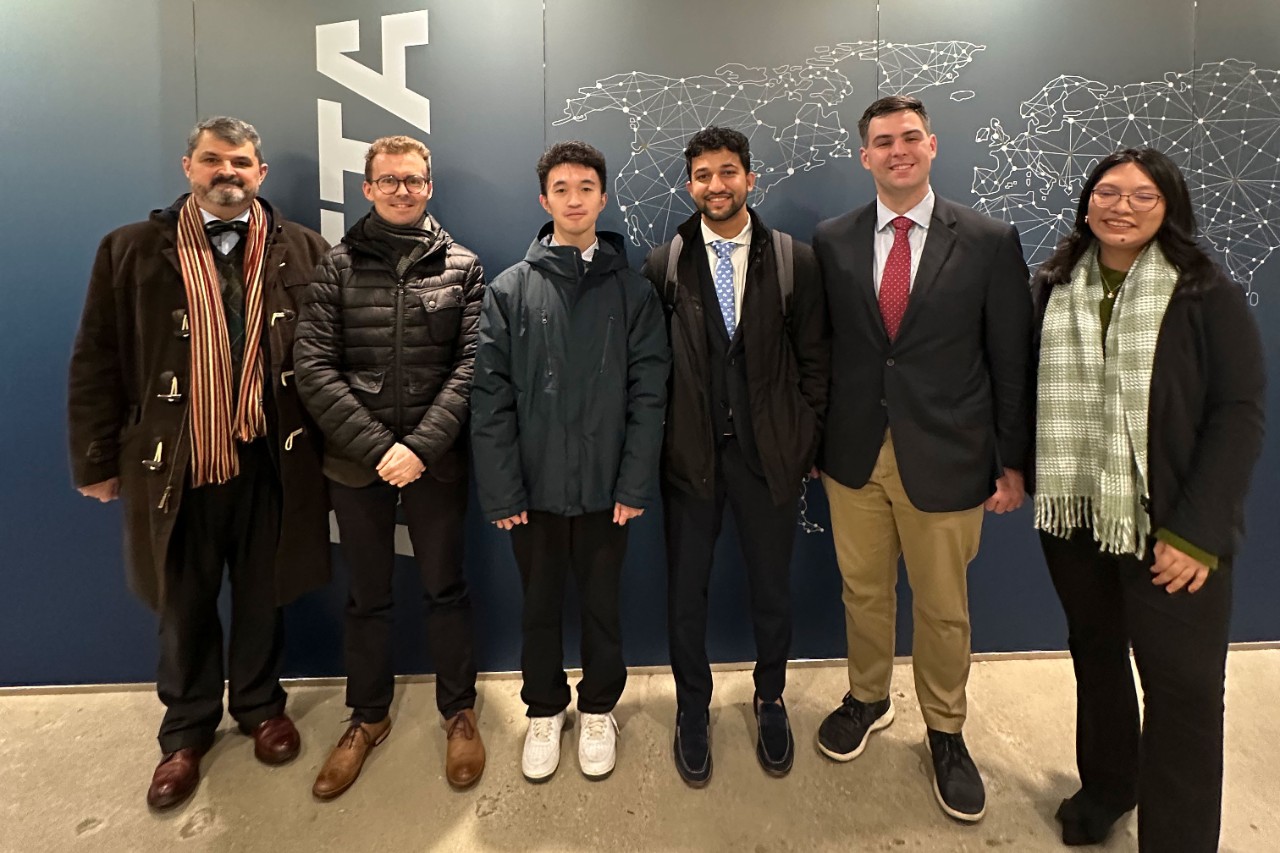
<p>In his <a href="https://www.sps.nyu.edu/experience/how-youll-learn/consulting-practicums.html">consulting practicum</a> project, <i>Examining Blockchain and Web3 Solutions to Music Streaming Fraud</i>, recent MS in Global Security, Conflict, and Cybercrime (<a href="https://www.sps.nyu.edu/explore/degrees-and-programs/ms-in-global-security-conflict-and-cybercrime.html">MSGSCC</a>) grad Moksh Mukkatira presented on the vulnerabilities and challenges facing digital platforms at the New York Metro Office of the National Cyber-Forensics & Training Alliance.</p>
<p>Research conducted by Mukkatira and teammate Armand Aibara explored the way bot-driven fake listens, hijacked subscriber accounts, AI-generated audio uploads, and fraudulent royalty claims exploit weaknesses in metadata integrity, verification standards, and reporting transparency, allowing fraudsters to siphon revenue and distort the music ecosystem. Mukkatira and Aibara then illustrated how blockchain and Web3 technologies could be leveraged to create a hybrid framework that anchors metadata on-chain while pairing it with off-chain, AI-powered fraud detection. This dual approach would offer transparency with flexibility, creating a pathway to more resilient verification systems without overwhelming existing workflows.</p>
<p>The team delivered a full presentation to NCFTA analysts that synthesized academic literature, case studies, stakeholder perspectives, and cybersecurity best practices into actionable recommendations—solutions that could be implemented in the often messy, high-pressure environments where cyber threats unfold.</p>
Engaging directly with practitioners who operate daily in high-stakes cyber threat environments forced us to sharpen our model and stress-test assumptions.”
Moksh Mukkatira
MS in Global Security, Conflict, and Cybercrime ‘25
<p>The team’s research underscored the fact that cross-sector collaboration is essential when addressing modern digital risks, and that fraud in music streaming is not just a technical issue; it intersects policy, economics, and the creative industries. By bridging these domains, Mukkatira and Aibara gained a deeper appreciation for the complexity of digital fraud and the importance of interdisciplinary problem-solving.</p>
<p>Now a <a href="https://www.sps.nyu.edu/about/academic-divisions-and-departments/center-for-global-affairs.html">Center for Global Affairs</a> graduate, Mukkatira hopes to continue his relationship with NCTFA and develop pragmatic solutions to help combat the ever-evolving complexities presented by cyber-enabled threats.</p>